MCQ
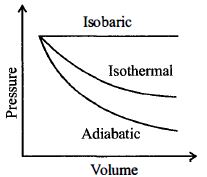
A sample of gas expands from $V_1$ to $V _2$. In which of the following, the work done will be greatest ?
  • A
    Same in all processes
  • Isobaric process
  • C
    Isothermal process
  • D
    Adiabatic process

Answer

Correct option: B.
Isobaric process
b
Work done $=$ Area bounded by $PV$ graph and volume axis
Among the three process, bounded area by $PV$ graph and volume axis is greatest for isobaric process, hence work done is greatest for isobaric process

Need a full question paper?

Generate a complete, print-ready paper with questions like this in minutes — across 16+ boards, with answer keys.

Start Generating Free

Similar questions

The width of river is $1\; km$. The velocity of boat is $5\; km/hr$. The boat covered the width of river with shortest will possible path in $15 \;min$. Then the velocity of river stream is
In an experiment four quantities $a, b, c$ and $d $ are measured with percentage error $1\%, 2\%, 3\%$ and $4\%$ respectively. Quantity $P$ is calculated as follows $P = \frac{{{a^3}{b^2}}}{{cd}}$. $ \%$ error in $P$ is ........ $\%$
An object is thrown along a direction inclined at an angle of ${45^o}$ with the horizontal direction. The horizontal range of the particle is equal to
One mole of an ideal gas at $STP$ is heated in an insulated closed container until the average speed of its molecules is doubled. Its pressure would therefore increase by factor.
The ratio ofthe radii of gyration of a circular disc about a tangential axis in the plane of the disc and of a circular ring of the same radius about a tangential axis in the plane of the ring is
If two vectors $\vec{A}$ and $\vec{B}$ having equal magnitude $\mathrm{R}$ are inclined at an angle $\theta$, then
The particles $A$ and $B$ of mass $m$ each are separated by a distance $r$. Another particle $C$ of mass $M$ is placed at the midpoint of $A$ and $B$. Find the work done in taking $C$ to a point equidistant $r$ from $A$ and $B$ without acceleration $(G=$ Gravitational constant and only gravitational interaction between $A, B$ and $C$ is considered) 
The time period of a geostationary satellite is $24\; \mathrm{h}$, at a helght $6 \mathrm{R}_{\mathrm{E}}( \mathrm{R}_{\mathrm{E}}$ is radius of earth) from surface of earth. The time period of another satellite whose helght is $2.5 \mathrm{R}_{\mathrm{E}}$ from surface will be
Young's modulus of a material has the same units as
A particle is rotated in a vertical circle by connecting it to a string of length $l$ and keeping the other end of the string fixed. The minimum speed of the particle when the string is horizontal for which the particle will complete the circle is: