MCQ
A satellite is moving with a constant speed ' $V$ ' in a circular orbit about the earth. An object of mass ' $m$ ' is ejected from the satellite such that it just escapes from the gravitational pull of the earth. At the time of its ejection, the kinetic energy of the object is
  • A
    $\frac{1}{2} m V^2$
  • $m V^2$
  • C
    $\frac{3}{2} m V^2$
  • D
    $2 m V^2$

Answer

Correct option: B.
$m V^2$
b
At height $r$ from center of earth. orbital velocity

$=\sqrt{\frac{\overline{G M}}{r}}$

$\therefore$ By energy conservation

KE of ' $m ^{\prime}+\left(-\frac{ GMm }{ r }\right)=0+0$

(At infinity, $PE = KE = o$ )

$\Rightarrow KE$ of ' m ' $=\frac{ GMm }{ r }=\left(\sqrt{\frac{ GM }{ r }}\right)^2 m= mv ^2$

Need a full question paper?

Generate a complete, print-ready paper with questions like this in minutes — across 16+ boards, with answer keys.

Start Generating Free

Similar questions

A force $\text{F}=-\text{kx}^2(\text{x}\neq0)$ acts on a particle in $X-$direction. Find the work done by the force in displacing the particle from $x = -a$ to $x = 2a.$
A body of mass $2 \,kg $ collides with a wall with speed $100\, m/s$ and rebounds with same speed. If the time of contact was $1/50 \,second$, the force exerted on the wall is
Two capillaries made of same material but of different radii are dipped in a liquid. The rise of liquid in one capillary is $2.2\, cm$ and that in the other is $6.6\, cm$. The ratio of their radii is
If a system is in thermodynamic equilibrium with its surroundings, it means:
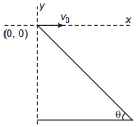
A man standing on a hill top projects a stone horizontally with speed $v_0$ as shown in figure. Taking the coordinates system as given in the figure. The coordinates of the point, where the stone will hit the hill surface are
Pascal's law states that pressure in a fluid at rest is the same at all points, if:
The angular momentum of a system of particles is not conserved when:
A massive ball moving with a speed in collide with a tiny ball having a very small mass, immediately after the impact the second ball will move at speed approximately equal to:
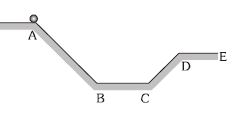
In the picture shown, a ball standing from rest rolls down a ramp $AB$, goes along at the horizontal bottom $BC$, and then backs up a smaller ramp $CD$, thereafter rolls on horizontal plane $DE$. Ignore friction and air resistance.Which of the following figure shows variation in speed with time ?
Which graph represents the uniform acceleration