MCQ
A force $\text{F}=-\text{kx}^2(\text{x}\neq0)$ acts on a particle in $X-$direction. Find the work done by the force in displacing the particle from $x = -a$ to $x = 2a.$
  • $\frac{3\text{k}}{2\text{a}}$
  • B
    $\frac{4\text{k}}{\text{a}^2}$
  • C
    $\frac{-3\text{k}}{2\text{a}^2}$
  • D
    $\frac{-9\text{k}}{\text{a}^2}$

Answer

Correct option: A.
$\frac{3\text{k}}{2\text{a}}$

Need a full question paper?

Generate a complete, print-ready paper with questions like this in minutes — across 16+ boards, with answer keys.

Start Generating Free

Similar questions

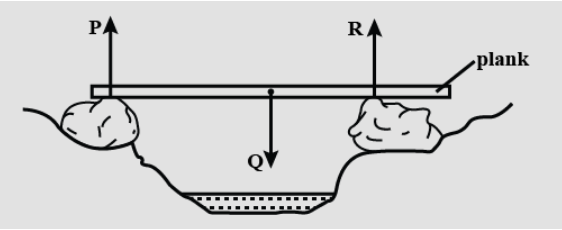
A wooden plank rests in equilibrium on two rocks on opposite sides of a narrow stream. Three forces $P, Q$ and $R$ act on the plank. How are the sizes of the forces related?
Four light waves are represented by
  1. $\text{y}=\text{a}_1\sin\omega\text{t}$
  2. $\text{y}=\text{a}_2\sin(\omega\text{t}+\in)$
  3. $\text{y}=\text{a}_1\sin2\omega\text{t}$
  4. $\text{y}=\text{a}_2\sin2(\omega\text{t}+\in)$
Interference fringes may be observed due to superposition of:
A mass $M$ moving with a certain speed $V$ collides elastically with another stationary mass $m$. After the collision, the masses $M$ and $m$ move with speeds $V^{\prime}$ and $v$, respectively. All motion is in one dimension. Then,
A force on an object of mass $100\, g$ is $(10 \hat{i}+5 \hat{j}) N$. The position of that object at $t=$ $2 s$ is $(a \hat{i}+b \hat{j}) m$ after starting from rest. The value of $\frac{a}{b}$ will be..........
A particle executing $SHM$ of amplitude $4\,cm$ and $T = 4s.$ The time taken by it to move from $+2\,cm$ to $+2\sqrt 3\,cm$ is
A sphere of radius $r$ is kept on a concave mirror of radius of curvature $R$. The arrangement is kept on a horizontal table (the surface of concave mirror is frictionless and sliding not rolling). If the sphere is displaced from its equilibrium position and left, then it executes $S.H.M.$ The period of oscillation will be
A bimetallic strip is formed out of two identical strips, one of copper and other of brass. The coefficients of linear expansion of the two metals are ${\alpha _C}$ and ${\alpha _{B}}.$ On heating, the temperature of the strip goes up by $\Delta T$ and the strip bends to form an arc of radius of curvature $R.$ Then $R$ is
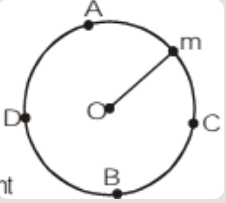
A mass is performing vertical circular motion $($see figure$)$. If the average velocity of the particle is increased, then at which point is the maximum breaking possibility of the string:
A particle is projected from ground with speed $80 \,m / s$ at angle $30^{\circ}$ with horizontal from ground. The magnitude of average velocity of particle in time interval $t=2 \,s$ to $t=6 \,s$ is ....... $m / s$ [Take $g=10 \,m / s ^2$ ]
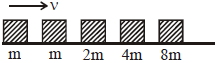
Blocks of masses $m , 2 m , 4 m$ and $8 m$ are arranged in a line on a frictionless floor. Another block of mass $m ,$ moving with speed $v$ along the same line (see figure) ollides with mass $m$ in perfectly inelastic manner. All the subsequent collisions are also perfectly inelastic. By the time the last block of mass $8 m$ starts moving the total energy loss is $p \%$ of the original energy. Value of $'p'$ is close to