Question
A satellite is projected vertically upwards from an earth station. At what height above the earth's surface will the force on the satellite due to the earth be reduced to half its value at the earth station? (Radius of the earth is 6400km.)

Answer

Let h be the height, M be the Earth's mass, R be the Earth's radius and m be the satellite's mass Force on the satellite due to the earth when it is at the Earth's surface, $\text{F}_1=\frac{\text{GMm}}{(\text{R + h})^2}$ Force on the satellite due to the earth when it is at height h above the Earth's surface, $\text{F}_2=\frac{\text{GMm}}{(\text{R + h})^2}$ According to question, we have:$\frac{\text{F}_1}{\text{F}_2}=\frac{(\text{R + h})^2}{\text{R}^2}$
$\Rightarrow2=\frac{(\text{R + h})^2}{\text{R}^2}$
Taking squareroot on both sides, we get:$\sqrt{2}=1+\frac{\text{h}}{\text{R}}$
$\Rightarrow\text{h}=(\sqrt{2}-1)\text{R}$
$=0.414\times6400=2649.6\text{km}\approx2650\text{km}$

Need a full question paper?

Generate a complete, print-ready paper with questions like this in minutes — across 16+ boards, with answer keys.
Start Generating Free

Similar questions

State Gauss theorem in electrostatics. Apply this theorem to obtain the expression for the electric field at a point due to an infinitely long, thin, uniformly charged straight wire of linear charge density $\lambda\text{Cm}^{-1}.$
Two particles A and B, each carrying a charge Q, are held fixed with a separation d between them. A particle C having mass m and charge q is kept at the middle point of the line AB.
  1. If it is displaced through a distance x perpendicular to AB, what would be the electric force experienced by it.
  2. Assuming x << d, show that this force is proportional to x.
  3. Under what conditions will the particle C execute simple harmonic motion if it is released after such a small displacement?
Find the time period of the oscillations if these conditions are satisfied.
What is meant by forward bias and reverse bias of p-n junction diode? Draw experimental electrical circuit diagram to study V-I characteristic in forward bias and reverse bias of p-n junction diode. Draw forward bias and reverse bias V-I characteristic curves of p-n junction diode and briefly explain the following :
(i) Threshold or cut-in voltage
(ii) Breakdown voltage.
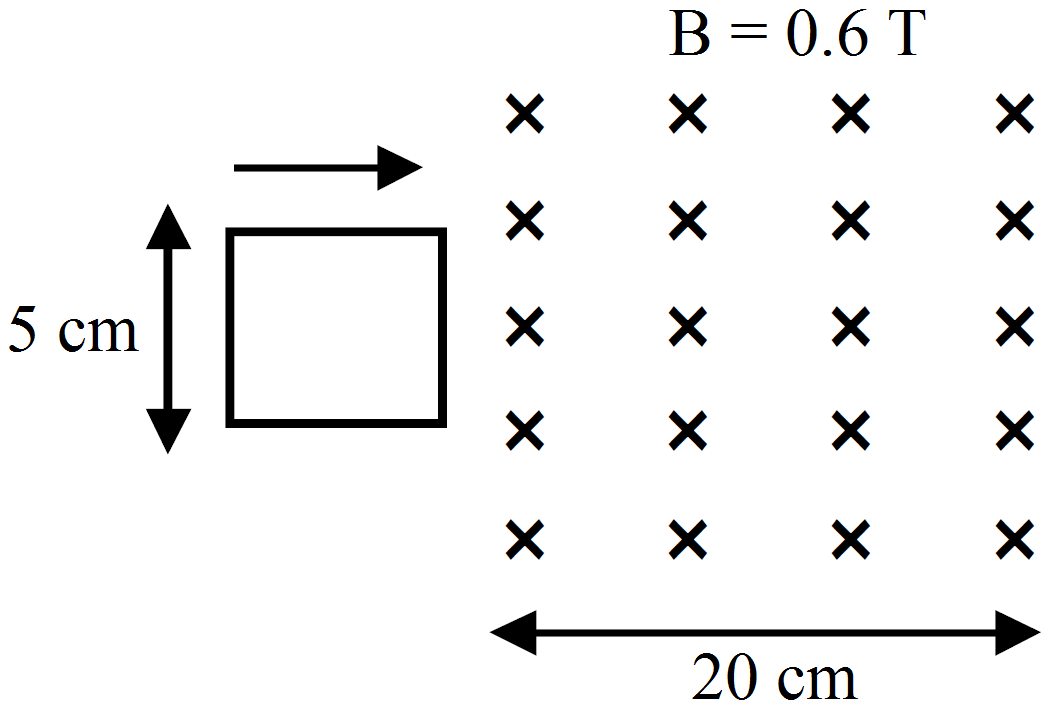
Figure shows a square loop of side 5cm being moved towards right at a constant speed of 1cm/s. The front edge enters the 20cm wide magnetic field at t = 0. Find the emf induced in the loop at:
  1. t = 2s
  2. t = 10s
  3. t = 22s
  4. t = 30s.
Find the magnetic field B at the centre of a rectangular loop of length l and width b, carrying a current i.
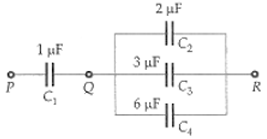
In Fig. the energy stored in $C _4$ is $27 J$ . Calculate the total energy stored in the system.
Image
A U-tube having unequal arm-lengths has water in it. A tuning fork of frequency 440Hz can set up the air in the shorter arm in its fundamental mode of vibration and the same tuning fork can set up the air in the longer arm in its first overtone vibration. Find the length of the air columns. Neglect any end effect and assume that the speed of sound in air = 330m/s.
For a circular coil of radius R and N turns carrying current I, the magnitude of the magnetic field at a point on its axis at a distance x from its centre is given by,
$\text{B}=\frac{\mu_{0}\text{IR}^{2}\text{N}}{2(\text{x}^{2}+\text{R}^{2})^{\frac{3}{2}}}$
  1. Show that this reduces to the familiar result for field at the centre of the coil.
  2. Consider two parallel co-axial circular coils of equal radius R, and number of turns N, carrying equal currents in the same direction, and separated by a distance R. Show that the field on the axis around the mid-point between the coils is uniform over a distance that is small as compared to R, and is given by,$\text{B}=0.72\frac{\mu_{0}\text{NI}}{\text{R}}$, approximately.
[Such an arrangement to produce a nearly uniform magnetic field over a small region is known as Helmholtz coils.]
Find the speed of an electron with kinetic energy:
  1. 1eV
  2. 10keV
  3. 10MeV
A body cools down from $50^\circ C$ to $45^\circ C$ in 5 minutes and to $40^\circ C$ in another 8 minutes. Find the temperature of the surrounding.