MCQ
A satellite revolves around the earth in an elliptical orbit. Its speed
  • A
    Is the same at all points in the orbit
  • Is greatest when it is closest to the earth
  • C
    Is greatest when it is farthest from the earth
  • D
    Goes on increasing or decreasing continuously depending upon the mass of the satellite
Answer

Correct option: B.
Is greatest when it is closest to the earth
(b)

Need a full question paper?

Generate a complete, print-ready paper with questions like this in minutes — across 16+ boards, with answer keys.

Start Generating Free

Similar questions

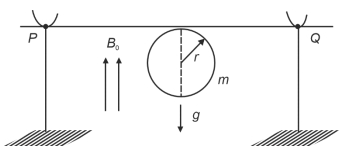
A thin stiff insulated metal wire is bent into a circular loop with its two ends extending tangentially from the same point of the loop. The wire loop has mass $m$ and radius $r$ and it is in a uniform vertical magnetic field $B_0$, as shown in the figure. Initially, it hangs vertically downwards, because of acceleration due to gravity $g$, on two conducting supports at $P$ and $Q$. When a current $/$ is passed through the loop, the loop turns about the line $P Q$ by an angle $\theta$ given by
A man crosses a $320 m$ wide river perpendicular to the current in 4 minutes. If in still water he can swim with a speed $5 / 3$ times that of the current, then the speed of the current, in $m / min$ is
Two forces of $12 N$ and $8 N$ act upon a body. The resultant force on the body has maximum value of
A copper voltameter is connected in series with a heater coil of resistance $0.1 \Omega$. A steady current flows in the circuit for twenty minutes and mass of $0.99 g$ of copper is deposited at the cathode. If electrochemical equivalent of copper is $0.00033 gm / C$, then heat generated in the coil is
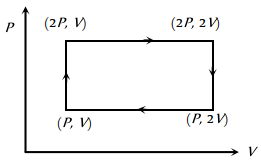
Work done in the given $P$ - $V$ diagram in the cyclic process is
Image
Pressure gradient has the same dimension as that of
A gas expands $0.25 \mathrm{~m}^3$ at constant pressure $10^3 \mathrm{~N} / \mathrm{m}^2$, the work done is
The number of turns in primary and secondary coils of a transformer are 100 and 20 respectively. If an alternating potential of 200 volt is applied to the primary, the induced potential in secondary will be
When unpolarised light beam is incident from air onto glass $(n=1.5)$ at the polarising angle
A particle of mass $m_1$ is moving with a velocity $v_1$ and another particle of mass $m_2$ is moving with a velocity $v_2$. Both of them have the same momentum but their different kinetic energies are $E_1$ and $E_2$ respectively. If $m_1>m_2$ then
  1. $E_1 < E_2$
  2. $\frac{E_1}{E_2}=\frac{m_1}{m_2}$
  3. $E_1>E_2$
  4. $E_1=E_2$