MCQ
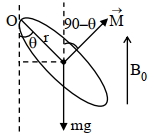
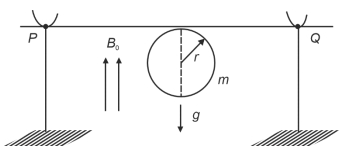
A thin stiff insulated metal wire is bent into a circular loop with its two ends extending tangentially from the same point of the loop. The wire loop has mass $m$ and radius $r$ and it is in a uniform vertical magnetic field $B_0$, as shown in the figure. Initially, it hangs vertically downwards, because of acceleration due to gravity $g$, on two conducting supports at $P$ and $Q$. When a current $/$ is passed through the loop, the loop turns about the line $P Q$ by an angle $\theta$ given by
- A$\tan \theta=\pi r I B_0 /(m g)$
- B$\tan \theta=2 \pi r I B_0 /(m g)$
- C$\tan \theta=\pi r I B_0 /(2 m g)$
- D$\tan \theta=m g /\left(\pi r / B_0\right)$