Question
A scientist is observing a bacteria through a compound microscope. For better analysis and to improve its resolving power he should. (Select the best option)

Answer

$P=\frac{2 \mu \sin \theta}{1.22 \lambda}$

Need a full question paper?

Generate a complete, print-ready paper with questions like this in minutes — across 16+ boards, with answer keys.
Start Generating Free

Similar questions

A thermally insulated rigid container of $1 \,L$ volume contains a diatomic ideal gas at room temperature. A small paddle installed inside the container is rotated from the outside, such that the pressure rises by $10^{5} \,Pa$. The change in internal energy is close to ............... $J$
In a common base transistor circuit, the current gain is $0.98$. On changing emitter current by $5.00 \,mA$, the change in collector current is ......... $mA$
In an $FM$ system a $7\, kHz$ signal modulates $108\, MHz$ carrier so that frequency deviation is $50\, kHz$. The carrier swing is
Plane angle and solid angle have :
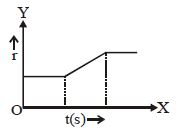
A flexible wire bent in the form of a circle is placed in a uniform magnetic field perpendicular to the plane of the coil. The radius of the coil changes as shown in figure. The graph of induced $emf$ in the coil is respresented by
A polyatomic gas $\left( {\gamma = \frac{4}{3}} \right)$ is compressed to $\frac{1}{8}$ of its volume adiabatically. If its initial pressure is ${P_o}$, its new pressure will be
A resistance of $40\, \Omega$ and an inductance of $95.5$ millihenry are connected in series in a $50$ cycles/second ac circuit. The impedance of this combination is very nearly.....$ohm$
$3\, A$ of current is flowing in a linear conductor having a length of $40\, cm$. The conductor is placed in a magnetic field of strength $500$ $gauss$ and makes an angle of $30^\circ $ with the direction of the field. It experiences a force of magnitude
The temperature at which the vapour pressure of a liquid becomes equals to the external (atmospheric) pressure is its
A body is moving with constant speed, in a circle of radius 10 m . The body completes one revolution in 4 s . At the end of 3rd second, the displacement of body (in m) from its starting point is: