$3\, A$ of current is flowing in a linear conductor having a length of $40\, cm$. The conductor is placed in a magnetic field of strength $500$ $gauss$ and makes an angle of $30^\circ $ with the direction of the field. It experiences a force of magnitude
Medium


Download our appand get started for free
Experience the future of education. Simply download our apps or reach out to us for more information. Let's shape the future of learning together!No signup needed.*
Similar Questions
- 1A wire of length $314\,cm$ carrying current of $14\,A$ is bent to form a circle. The magnetic moment of the coil is $........A- m ^{2}$. [Given $\left.\pi=3.14\right]$View Solution
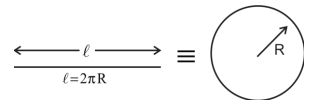
- 2The magnetic field at the centre of a circular coil of radius $I$, due to current I flowing through it, is $B$. The magnetic field at a point along the axis at a distance $\frac{r}{2}$ from the centre isView Solution
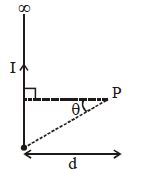
- 3Magnetic field due to semi infinite length wire at point $P$View Solution
- 4A galvanometer of resistance $100\,\Omega $ has $50\, divisions$ on its scale and has sensitivity of $20\,\mu A / division$. It is to be converted to a voltmeter with three ranges, of $0-2\, V$, $0-10\, V$ and $0-20\, V$. The appropriate circuit to do so isView Solution
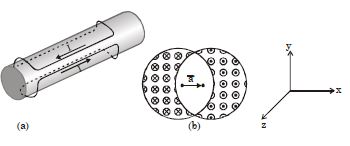
- 5To produce a uniform magnetic field directed parallel to a diameter of a cylindrical region, one can use the saddle coils illustrated in figure. The loops are wrapped over a somewhat flattened tube. Assume the straight sections of wire are very long. The end view of the tube shows how the windings are applied. The overall current distribution is the superposition of two overlapping,circular cylinders of uniformly distributed current, one toward you and one away from you. The current density $J$ is the same for each cylinder. The position of the axis of one cylinder is described by a position vector a relative to the other cylinder. The magnetic field inside the hollow tube is.View Solution
- 6An electron is accelerated by a potential difference of $12000\, volts$. It then enters a uniform magnetic field of ${10^{ - 3}}\,T$ applied perpendicular to the path of electron. Find the radius of path. Given mass of electron $ = 9 \times {10^{ - 31}}\,kg$ and charge on electron $ = 1.6 \times {10^{ - 19}}\,C$View Solution
- 7A ring of radius $R$, made of an insulating material carries a charge $Q$ uniformly distributed on it. If the ring rotates about the axis passing through its centre and normal to plane of the ring with constant angular speed $\omega $, then the magnitude of the magnetic moment of the ring isView Solution
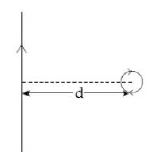
- 8An infinitely long current carrying wire and a small current carrying loop are in the plane of the paper as shown. the radius of the loop is $a$ and distance of its centre from the wire is $d (d >> a)$. If the loop applies a force $F$ on the wire thenView Solution
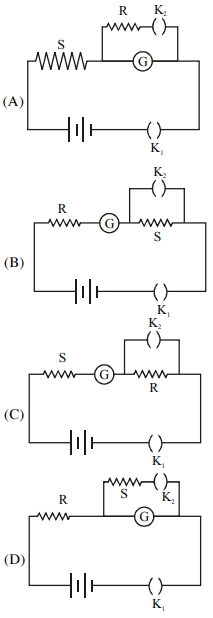
- 9In the circuit diagrams $(A, B, C$ and $D$) shown below, $R$ is a high resistance and $S$ is a resistance of the order of galvanometer resistance $G$. The correct circuit, corresponding to the half deflection method for finding the resistance and figure of merit of the galvanometer, is the circuit labelled asView Solution
- 10In an experiment, electrons are accelerated, from rest, by applying, a voltage of $500 \,V.$ Calculate the radius of the path if a magnetic field $100\,mT$ is then applied. [Charge of the electron $= 1.6 \times 10^{-19}\,C$ Mass of the electron $= 9.1 \times 10^{-31}\,kg$ ]View Solution