MCQ
A scientist is observing a bacteria through a compound microscope. For better analysis and to improve its resolving power he should. (Select the best option)
  • A
    Increase the wave length of the light.
  • Increase the refractive index of the medium between the object and objective lens.
  • C
    Decrease the focal length of the eye piece.
  • D
    Decrease the diameter of the objective lens.
Answer

Correct option: B.
Increase the refractive index of the medium between the object and objective lens.
b
$P=\frac{2 \mu \sin \theta}{1.22 \lambda}$

Need a full question paper?

Generate a complete, print-ready paper with questions like this in minutes — across 16+ boards, with answer keys.

Start Generating Free

Similar questions

Consider an electron in a hydrogen atom, revolving in its second excited state (having radius $4.65\, \mathop A\limits^o $). The de-Broglie wavelength of this electron is....$\mathop A\limits^o $
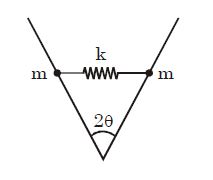
Two particles of mass $m$ are constrained to move along two horizontal frictionless rails that make an angle $2\theta $ with respect to each other. They are connected by a spring with spring constant $k$ . The angular frequency of small oscillations for the motion where the two masses always stay parallel to each other (that is the distance between the meeting point of the rails and each particle is equal) is 
In the double slit experiment when a glass plate (refractive index $1.5$) of thickness $t$ is introduced in the path of one of the interfering beams (wavelength $\lambda $), intensity at the position where the central maximum occurred previously remains unchanged. Minimum thickness of the glass plate is
The phenomenon of diffraction of light was discovered by
The correct order of their reactivity towards hydrolysis at room temperature is :
A galvanometer is connected to the secondary coil. The galvanometer shows an instantaneous deflection of 7 divisions when current is started in the primary coil of the solenoid. Now, if the primary coil is suddenly rotated through $180^{\circ}$, then the new instantaneous deflection will be:
A police car with a siren of frequency $8$ $kHz$ is moving with uniform velocity $36$ $km/hr$ towards a tall building which reflects the sound waves. The speed of sound in air is $320$ $m/s$. The frequency of the siren heard by the car driver is .... $kHz$
Two identical balls $P$ and $Q$ moving in the $x-y$ plane collide at the origin $(x=0,y=0)$ of the coordinate system. Their velocity components just before the moment of impact were, for ball $P$, $v_x=6\ m/s$, $v_y=0$; for ball $Q$, $v_x=-5\ m/s$, $v_y=2\ m/s$. As a result of the collision, the ball $P$ comes to rest. The velocity components of the ball $Q$ just after collision will be
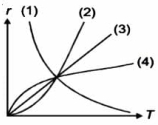
Which graph best represents the variation of radius $r$ of a circular orbit of a satellite against its time period $T$ ?
A vector $\vec Q$ which has a magnitude of $8$ is added to the vector $\vec P$ which lies along $x-$ axis. The resultant of two vectors lies along $y-$ axis and has magnitude twice that of  $\vec P$. The magnitude of is $\vec P$