- 500N throughout the journey.
- Less than 500N throughout the journey.
- More than 500N throughout the journey.
- > 500N for time $\triangle\text{t}_1$ and $\triangle\text{t}_3$ and 500N for $\triangle\text{t}_2.$
Explanation:
During the time interval $\triangle\text{t}_2,$ the scooter is moving with a constant velocity, which implies that the force exerted by the seat on the man is 500N (for balancing the weight of the man).
During the time interval $\triangle\text{t}_1$ and $\triangle\text{t}_3,$ the scooter is moving with constant acceleration and deceleration, which implies that a frictional force is also applied. Therefore, the net force exerted by the seat on the man should be > 500N.
Generate a complete, print-ready paper with questions like this in minutes — across 16+ boards, with answer keys.
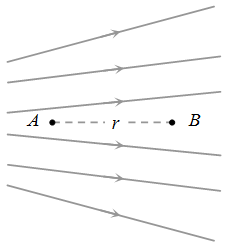
Figure shows the electric lines of force emerging from a charged body. If the electric field at A and B are
and
respectively and if the displacement between A and B is r then

|
(a) |
(b) |
(c) |
(d) |
Light of frequency n is incident on a certain photoelectric substance with threshold frequency n0. The work function for the substance is
|
(a) hn |
(b) hn0 |
(c) |
(d) |

A light source approaches the observer with velocity 0.8 c. The doppler shift for the light of wavelength 5500 Å is
|
(a) 4400 Å |
(b) 1833 Å |
(c) 3167 Å |
(d) 7333 Å |
Which of the following is true for photon
|
(a) E = |
(b) E = |
(c) p = |
(d) E = |