- Must be less than 10cm.
- Must be greater than 20cm.
- Must not be greater than 20cm.
- Must not be less than 10cm.
Explanation:
$\text{v}=(40-4)$
$\frac{1}{\text{f}}=\frac{1}{40-4}-\frac{1}{(-\text{u})}$
$\frac{\text{df}}{\text{du}}=0$ for f minimum.
$\frac{\text{df}}{\text{du}}=1-\frac{\text{u}}{20}=0$
$\text{u}=20$
$\text{f}_{\text{min}}=10\text{cm}$
Generate a complete, print-ready paper with questions like this in minutes — across 16+ boards, with answer keys.
A galvanometer coil of resistance 50 W, show full deflection of 100 μA. The shunt resistance to be added to the galvanometer, to work as an ammeter of range 10 mA is
|
(a) 5 W in parallel |
(b) 0.5 W in series |
(c) 5 W in series |
(d) 0.5 W in parallel |
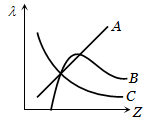
The variation of wavelength λ of the
line with atomic number Z of the target is shown by the following curve of

|
(a) A |
(b) B |
(c) C |
(d) None of these |
In a certain charge distribution, all points having zero potential can be joined by a circle S. Points inside S have positive potential and points outside S have negative potential. A positive charge, which is free to move, is placed inside S
|
(a) It will remain in equilibrium |
|
(b) It can move inside S, but it cannot cross S |
|
(c) It must cross S at some time |
|
(d) It may move, but will ultimately return to its starting point |