MCQ
Coulomb's law is a confirmation of______
- Ainverse cube law
- Bproduct law
- Cinverse square law
- DNone of the above
Explanation:
According to Coulomb's Law-
$\text{F}\propto\frac{1}{\text{r}^2}$
Hence, Coulomb's Law is a confirmation of inverse square law.
Generate a complete, print-ready paper with questions like this in minutes — across 16+ boards, with answer keys.
A positively charged particle moving along x-axis with a certain velocity enters a uniform electric field directed along positive y-axis. Its
|
(a) Vertical velocity changes but horizontal velocity remains constant |
|
(b) Horizontal velocity changes but vertical velocity remains constant |
|
(c) Both vertical and horizontal velocities change |
|
(d) Neither vertical nor horizontal velocity changes |
The frequencies of X-rays, g-rays and ultraviolet rays are respectively a, b and c. Then
|
(a) a < b, b > c |
(b) a > b, b > c |
(c) a > b, b < c |
(d) a < b, b < c |
In Young's double slit experiment when wavelength used is 6000 Å and the screen is 40 cm from the slits, the fringes are 0.012 cm wide. What is the distance between the slits
|
(a) 0.024 cm |
(b) 2.4 cm |
(c) 0.24 cm |
(d) 0.2 cm |
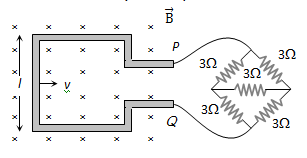
A square metallic wire loop of side 0.1 m and resistance of 1W is moved with a constant velocity in a magnetic field of 2 wb/m2 as shown in figure. The magnetic field is perpendicular to the plane of the loop, loop is connected to a network of resistances. What should be the velocity of loop so as to have a steady current of 1mA in loop
|
(a) 1 cm/sec |
(b) 2 cm/sec |
(c) 3 cm/sec |
(d) 4 cm/sec |
A charge +Q is moving upwards vertically. It enters a magnetic field directed to the north. The force on the charge will be towards
|
(a) North |
(b) South |
(c) East |
(d) West |
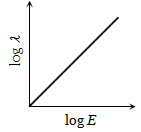
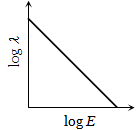
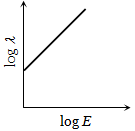
The log-log graph between the energy E of an electron and its de-Broglie wavelength λ will be
|
(a)
|
(a)
|
(c)
|
(d)
|