MCQ
A screw gauge has $50$ divisions on its circular scale. The circular scale is $4$ units ahead of the pitch scale marking, prior to use. Upon one complete rotation of the circular scale, a displacement of $0.5\, mm$ is noticed on the pitch scale. The nature of zero error involved, and the least count of the screw gauge, are respectively
  • A
    Negative, $2\, \mu m$
  • Positive, $10\, \mu m$
  • C
    Positive, $0.1$ $\mu m$
  • D
    Positive, $0.1$ $mm$

Answer

Correct option: B.
Positive, $10\, \mu m$
b
Least count of screw gauge

$=\frac{\text { Pitch }}{\text { no. of division on circular scale }}$

$=\frac{0.5}{50} mm =1 \times 10^{-5} m$

$=10\, \mu m$

Zero error in positive

Need a full question paper?

Generate a complete, print-ready paper with questions like this in minutes — across 16+ boards, with answer keys.

Start Generating Free

Similar questions

Given vector $\overrightarrow A = 2\hat i + 3\hat j, $ the angle between $\overrightarrow A $and $y-$axis is
A person brings a mass of $1 \ kg$ from infinity to a point $A .$ Initially the mass was at rest but it moves at a speed of $2 \mathrm{~ms}^{-1}$ as it reaches $A .$ The work done by the person on the mass is $-3 J$ . The potential at $A$ is:
 
A metre scale is balanced on a knife edge at its centre. When two coins, each of mass $10\, g$ are put one on the top of the other at the $10.0\, cm$ mark the scale is found to be balanced at $40.0\, cm$ mark. The mass of the metre scale is found to be $x \times 10^{-2}$ $kg$. The value of $x$ is
Two spheres of masses $2M$ and $M$ are initially at rest at a distance $R$ apart. Due to mutual force of attraction they approach each other. When they are at separation $R/2,$ the acceleration of the centre of mass of sphere would be ....... $gm/s^2$
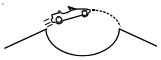
A stunt man jumps his car over a crater as shown (neglect air resistance)
In an clockwise system
The ratio of the dimension of Planck's constant and that of moment of inertia is the dimension of
A person of mass $M$ is, sitting on a swing of length $L$ and swinging with an angular amplitude $\theta_0$. If the person stands up when the swing passes through its lowest point, the work done by him, assuming that his centre of mass moves by a distance $l\, ( l < < L)$, is close to
If force $(F),$ velocity $(V)$ and time $(T)$ are taken as fundamental units, then the dimensions of mass are 
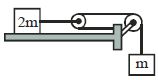
Consider the situation shown in figure. All the surfaces are smooth. The tension in the string connected to $2\,m$ is