- ✓$\frac{l}{4}, \frac{l}{2}$
- B$\frac{l}{4}, \frac{3l}{4}$
- C$\frac{l}{2}, \frac{l}{2}$
- D$\frac{l}{2}, \frac{3l}{4}$
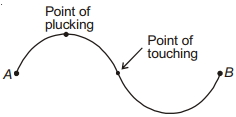
In the $2^{\text {nd }}$ harmonic the shape of wave looks like.
The point of touching forms a node point of plucking forms an antinode. Hence, for $2^{\text {nd }}$ harmonic, we need to need wire touched at $\frac{l}{2}$ and pluck it at $\frac{l}{4}$.
Generate a complete, print-ready paper with questions like this in minutes — across 16+ boards, with answer keys.
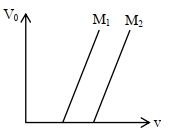
Statement-$I$: Figure shows the variation of stopping potential with frequency $(v)$ for the two photosensitive materials $M_1$ and $M_2$. The slope gives value of $\frac{h}{e}$, where $h$ is Planck's constant, $e$ is the charge of electron.
Statement-$II$: $M_2$ will emit photoelectrons of greater kinetic energy for the incident radiation having same frequency.
In the light of the above statements, choose the most appropriate answer from the options given below.