Question
A second harmonic has to be generated in a string of length $l$ stretched between two rigid supports. The point where the string has to be plucked and touched are
For second harmonic, wavelength $\left(\lambda_{2}\right)$ of the standing waves set up on the corresponds to the $n=2$
Thus, $\lambda_{n}=\frac{2 l}{n}$
$\Rightarrow \lambda_{2}=\frac{2 l}{2}=l$
This shows that we have an antinode at $l / 2$
This shows that we have an node at $l / 4$
Generate a complete, print-ready paper with questions like this in minutes — across 16+ boards, with answer keys.
| Column $I$ | Column $II$ |
| $(A)$ Transition between two atomic energy levels | $(p)$ Characteristic $X$-rays |
| $(B)$ Electron emission from a material | $(q)$ Photoelectric effect |
| $(C)$ Mosley's law | $(r)$ Hydrogen spectrum |
| $(D)$ Change of photon energy into kinetic energy of electrons | $(s)$ $\beta$-decay |
${z_1},{z_2}$ and ${z_3}$ as${z_1} = A\sin (kx - \omega \,t)$, ${z_2} = A\sin (kx + \omega \,t)$ and ${z_3} = A\sin (ky - \omega \,t)$.
Which of the following represents a standing wave
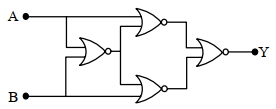
The truth table for the given figure is :