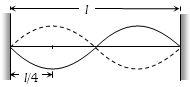
A second harmonic has to be generated in a string of length $l$ stretched between two rigid supports. The point where the string has to be plucked and touched are
APlucked at $\frac{l}{4}$ and touch at $\frac{l}{2}$
BPlucked at $\frac{l}{4}$ and touch at $\frac{{3l}}{4}$
CPlucked at $\frac{l}{2}$ and touched at $\frac{l}{4}$
DPlucked at $\frac{l}{2}$ and touched at $\frac{{3l}}{4}$
Medium
Download our app for free and get started
APlucked at $\frac{l}{4}$ and touch at $\frac{l}{2}$
a (a) Second harmonic means $2$ loops in a total length
Hence plucking distance from one end $ = \frac{l}{{2p}} = \frac{l}{{2 \times 2}} = \frac{l}{4}.$
Download our app
and get started for free
Experience the future of education. Simply download our apps or reach out to us for more information. Let's shape the future of learning together!No signup needed.*
Two whistles $A$ and $B$ produces notes of frequencies $660 Hz$ and $596 Hz$ respectively. There is a listener at the mid-point of the line joining them. Now the whistle $B$ and the listener start moving with speed $30 m/s$ away from the whistle $A.$ If speed of sound be $330 m/s,$ how many beats will be heard by the listener
Two engines pass each other moving in opposite directions with uniform speed of $30\,m/s$ . One of them is blowing a whistle of frequency $540\,Hz.$ Calculate the frequency heard by driver of second engine before they pass each other ... $Hz$. Speed of sound is $330\,m/sec$
Equation of a progressive wave is given by $y = a\,\sin \pi \,\left[ {\frac{t}{2} - \frac{x}{4}} \right]\,,$ where $t$ is in seconds and $x$ is in meters. The distance through which the wave moves in $8 sec$ is .... $(m)$ (in meter)
Two generators $S_1$ and $S_2$ produce water wave of equal frequency. A point $P$ is located such that $(S_1P -S_2P)$ is equal to half a wavelength. When operated alone, $S_1$ produces an oscillation of amplitude $2a$ at $P$ while $S_2$ produces an oscillation of amplitude $a$ . If the generators are operated in phase, which graph correctly shows the resultant oscillation at $P$ ?
Figure shows a snapshot for a travelling sine wave along a string. Four elemental portions $a, b, c$ and $d$ are indicated on the string. The elemental portion which has maximum potential energy is/are
A person observes two moving trains, '$A$' reaching the station and '$B$' leaving the station with equal speed of $30\,m / s$. If both trains emit sounds with frequency $300\,Hz$, (Speed of sound : $330\,m / s$ ) approximate difference of frequencies heard by the person will be $..........Hz$
A tuning fork gives $4$ beats with $50\, cm$ length of a sonometer wire if the length of the wire is shortened by $1\, cm$. the no. of beats still the same. The frequency of the fork is -............. $\mathrm{Hz}$
Two waves are represented by ${y_1} = a\sin \left( {\omega \,t + \frac{\pi }{6}} \right)$ and ${y_2} = a\cos \omega \,t$. What will be their resultant amplitude