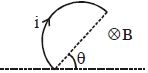
A semicircular ring of radius $R$ carrying current $i$ is placed in a magnetic field of intensity $B$ so that plane of wire is perpendicular to magnetic field as shown. Net force acting on the ring is
Easy
Download our app for free and get started
$\vec F\, = \,i(\vec l \times \vec B)$
$= i \times 2r \times B$
$= i2rB$
$= 2irB$

Download our appand get started for free
Experience the future of education. Simply download our apps or reach out to us for more information. Let's shape the future of learning together!No signup needed.*
Similar Questions
- 1The resistance of a galvanometer is $50\,\Omega $ and it requires $2\,\mu A$ per two division deflection. The value of the shunt required in order to convert this galvanometer into ammeter of range $5\,A$ is (The number of divisions on the galvanometer scale on one side is $30$)View Solution
- 2A current carrying long solenoid is placed on the ground with its axis vertical. A proton is falling along the axis of the solenoid with a velocity $v$. When the proton enters into the solenoid, it willView Solution
- 3View SolutionThe direction of magnetic lines of forces close to a straight conductor carrying current will be
- 4View SolutionMotion of a moving electron is not affected by
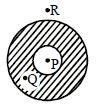
- 5View SolutionCurrent is flowing through a conducting hollow pipe whose area of cross-section is shown in the figure. The value of magnetic induction will be zero at
- 6View SolutionA cell is connected between two points of a uniformly thick circular conductor. The magnetic field at the centre of the loop will be
- 7A particle of mass $m$ and charge $q$, accelerated by a potential difference $V$ enters a region of a uniform transverse magnetic field $B$. If $d$ is the thickness of the region of $B$, the angle $\theta$ through which the particle deviates from the initial direction on leaving the region is given byView Solution
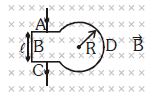
- 8The figure shows a conducting loop $ABCDA$ placed in a uniform magnetic field perpendicular to its plane. The part $ABC$ is the $(3/4)^{th}$ portion of the square of side length $l$ . The part $ADC$ is a circular arc of radius $R$ . The points $A$ and $C$ are connected to a battery which supply a current $I$ to the circuit. The magnetic force on the loop due to the field $B$ isView Solution
- 9A charged particle moves along circular path in a uniform magnetic field in a cyclotron. The kinetic energy of the charged particle increases to $4$ times its initial value. What will be the ratio of new radius to the original radius of circular path of the charged particleView Solution
- 10A circular coil ‘$A$’ has a radius $R$ and the current flowing through it is $I$. Another circular coil ‘$B$’ has a radius $2R$ and if $2I$ is the current flowing through it, then the magnetic fields at the centre of the circular coil are in the ratio of (i.e.${B_A}$ to ${B_B}$)View Solution