MCQ
A semiconductor is a material with a small but non$-$zero band gap that behaves as an insulator at absolute zero but allows thermal excitation of electrons into its $.........$ at temperatures that are below its melting point.
  • A
    $\text{HOMO}$
  • B
    Valence band
  • Conduction band
  • D
    $\text{LUMO}$

Answer

Correct option: C.
Conduction band
The band gap in case of semiconductors is of order $3−4\  eV.$  At absolute zero, the valence band is filled and conduction band is empty, so it behaves as an insulator. As the temperature is raised, electrons in the valence band gain sufficient energy to overcome the band gap and jump to the conduction band.

Need a full question paper?

Generate a complete, print-ready paper with questions like this in minutes — across 16+ boards, with answer keys.

Start Generating Free

Similar questions

Which of the following is wrong for interference fringes?
Wavelength of light of frequency $100\;Hz$
When a charged particle moves through a magnetic field, the quantity which is not affected in the magnetic field is:
The work function of tungsten is $4.50\,eV$. The wavelength of fastest electron emitted when light whose photon energy is $5.50 \,eV$ falls on tungsten surface, is ......... $\mathring A$
A conducting body $1$ has some initial charge $Q$, and its capacitance is $C$. There are two other conducting bodies, $2$ and $3$, having capacitances : $C_2 = 2C$ and $C_3 \rightarrow \infty$ . Bodies $2 $ and $3 $ are initially uncharged. "Body $2$ is touched with body $1$. Then, body $2$ is removed from body $1 $ and touched with body $3$, and then removed." This process is repeated $N$ times. Then, the charge on body $1$ at the end must be
Which of the following particles will have minimum frequency of revolution when projected with the same velocity perpendicular to a magnetic field?
When the kinetic energy of an electron is increased, the wavelength of the associated wave will
Ten charges are placed on the circumference of a circle of radius $R$ with constant angular separation between successive charges. Alternate charges $1,3,5,7,9$ have charge $(+q)$ each, while $2,4,6,8,10$ have charge $(-q)$ each. The potential $V$ and the electric field $E$ at the centre of the circle are respectively

(Take $V =0$ at infinity $)$

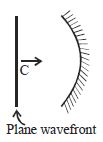
When a plane wave front incident on a concave mirror as shown in figure then shape of reflected wave front
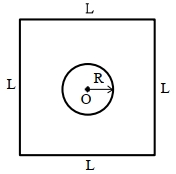
Find the mutual inductance in the arrangement, when a small circular loop of wire of radius ' $R$ ' is placed inside a large square loop of wire of side $L$ $( L \gg R )$. The loops are coplanar and their centres coincide :