A series combination of three capacitors of capacities $1\,\mu \,F,\,2\,\mu \,F$ and $8\,\mu \,F$ is connected to a battery of $e.m.f.$ $13\, volt$. The potential difference across the plates of $2\,\mu \,F$ capacitor will be.....$V$
Medium


Download our appand get started for free
Experience the future of education. Simply download our apps or reach out to us for more information. Let's shape the future of learning together!No signup needed.*
Similar Questions
- 1A negatively charged plate has charge density of $2 \times {10^{ - 6}}\,C/{m^2}$. The initial distance of an electron which is moving toward plate, cannot strike the plate, if it is having energy of $200\,eV$View Solution
- 2Three capacitors each of capacity $4\,\mu \,F$ are to be connected in such a way that the effective capacitance is $6\,\mu \,F$. This can be done byView Solution
- 3Condenser $A$ has a capacity of $15\,\mu F$ when it is filled with a medium of dielectric constant $15$. Another condenser $B$ has a capacity of $1\,\mu F$ with air between the plates. Both are charged separately by a battery of $100\;V$. After charging, both are connected in parallel without the battery and the dielectric medium being removed. The common potential now is.....$V$View Solution
- 4There are two identical capacitors, the first one is uncharged and filled with a dielectric of constant $K$ while the other one is charged to potential $V$ having air between its plates. If two capacitors are joined end to end, the common potential will beView Solution
- 5Two equal charges $q$ are placed at a distance of $2a$ and a third charge $ - 2q$ is placed at the midpoint. The potential energy of the system isView Solution
- 6Three capacitors of capacity ${C_1},\;{C_2}\;{C_3}$ are connected in series. Their total capacity will beView Solution
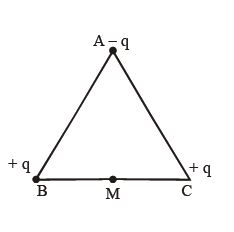
- 7Charges $-q,\, q,\,q$ are placed at the vertices $A$, $B$, $C$ respectively of an equilateral triangle of side $'a'$ as shown in the figure. If charge $-q$ is released keeping remaining two charges fixed, then the kinetic energy of charge $(-q)$ at the instant when it passes through the mid point $M$ of side $BC$ isView Solution
- 8View SolutionConsider the points lying on a straight line joining two fixed opposite charges. Between the charges there is
- 9If $4 \times {10^{20}}eV$ energy is required to move a charge of $0.25$ coulomb between two points. Then what will be the potential difference between them......$V$View Solution
- 10At distance of $5$ $cm$ and $10$ $cm $ outwards from the surface of a uniformly charged solid sphere, the potentials are $100$ $V$ and $75$ $V$ respectively . ThenView Solution