Condenser $A$ has a capacity of $15\,\mu F$ when it is filled with a medium of dielectric constant $15$. Another condenser $B$ has a capacity of $1\,\mu F$ with air between the plates. Both are charged separately by a battery of $100\;V$. After charging, both are connected in parallel without the battery and the dielectric medium being removed. The common potential now is.....$V$
Diffcult


Download our appand get started for free
Experience the future of education. Simply download our apps or reach out to us for more information. Let's shape the future of learning together!No signup needed.*
Similar Questions
- 1View SolutionChoose the incorrect statement from the following: When two identical capacitors are charged individually to different potentials and connected parallel to each other after disconnecting them from the source
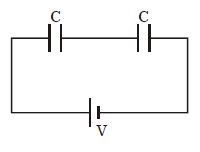
- 2Initially the circuit is in steady state. Now one of the capacitor is filled with dielectric of dielectric constant $2$ . Find the heat loss in the circuit due to insertion of dielectricView Solution
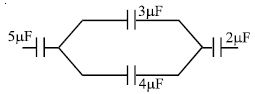
- 3If charge on left plane of the $5\ \mu F$ capacitor in the circuit segment shown in the figure is $-20\ \mu C$, the charge on the right plate of $3\ \mu F$ capacitor is.......$ \mu C$View Solution
- 4View SolutionThe electric potential inside a conducting sphere
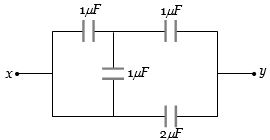
- 5Four capacitors are connected as shown in the figure. Their capacities are indicated in the figure. The effective capacitance between points $x$ and $y$ is (in $\mu F$)View Solution
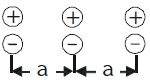
- 6Three identical small electric dipoles are arranged parallel to each other at equal separation a as shown in the figure. Their total interaction energy is $U$. Now one of the end dipole is gradually reversed, how much work is done by the electric forces.View Solution
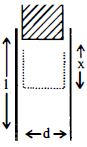
- 7A parallel plate capacitor is made of two plates of length $l$, width $w$ and separated by distance $d$. A dielectric slab ( dielectric constant $K$) that fits exactly between the plates is held near the edge of the plates. It is pulled into the capacitor by a force $F = -\frac{{\partial U}}{{\partial x}}$ where $U$ is the energy of the capacitor when dielectric is inside the capacitor up to distance $x$ (See figure). If the charge on the capacitor is $Q$ then the force on the dielectric when it is near the edge isView Solution
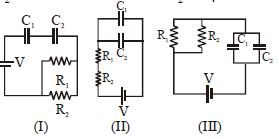
- 8Given,View Solution
${R_1} = 1\,\Omega $ $C_1 \,= 2\,\mu F$
${R_2} = 2\,\Omega $ $C_2 \,= 4\,\mu F$
The time constants ( in $\mu\, s$) for the circuits $I, II, III$ are respectively
- 9While working on a physics project at school physics lab, you require a $4 \,\mu F$ capacitor in a circuit across a potential difference of $1 \,kV$. Unfortunately, $4 \,\mu F$ capacitors are out of stock in your lab but $2 \,\mu F$ capacitors which can withstand a potential difference of $400 \,V$ are available in plenty. If you decide to use the $2 \,\mu F$ capacitors in place of $4 \,\mu F$ capacitor, minimum number of capacitors required areView Solution
- 10View SolutionThe energy stored in a condenser is in the form of