Question
A series L-C-R circuit is connected to an AC source. Using the phasor diagram, derive the expression for the impedance of the circuit. Plot a graph to show the variation of current with frequency of the source, explaining the nature of its variation.
Answer

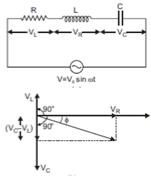
Suppose a resistance R , inductance L and capacitance C in series. An alternating source of voltage $V = V _{ o }$ sin $\omega t$ is applied across it. Since all the components are connected in series, the current flowing through all is same.
Voltage across resistance R is $V _{ R }$, voltage across inductance L is $V _{ L }$ and voltage across capacitance C is $V _{ C }$. 
$V _{ R }$ and $\left( V _{ C }- V _{ L }\right)$ are mutually perpendicular and the phase difference between them is $90^{\circ}$.
Image

From the figure above, we have 
$V^2=V_R^2+\left(V_C-V_L\right)^2 \Rightarrow V=\sqrt{V_R^2+\left(V_C-V_L\right)^2} \ldots \ldots$ (i)
and $V_R=R i, V_C=X_C i$ and $V_L=V_L i \ldots$. (ii)
where $X _{ C }=\frac{1}{\omega C}=$ capacitance reactance and $X _{ L }=\omega L=$ inductive reactance
$\therefore \quad V=\sqrt{(R i)^2+\left(X_C i-X_L i\right)^2}$
$\therefore$ Impendance of circuit, $Z=\frac{V}{i}=\sqrt{R^2+\left(X_C-X_L\right)^2}$
i.e. $Z=\sqrt{R^2+\left(X_C-X_L\right)^2}=\sqrt{R^2+\left(\frac{1}{\omega C}-\omega L\right)^2}$
The phase difference between current and voltage is given by, 
$\tan \phi=\frac{X_C-X_L}{R}$
Image

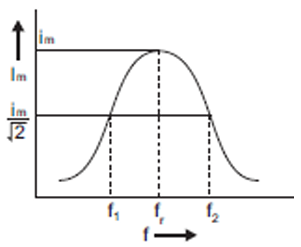
From the graph, we can see that with increase in frequency, current first increases and then decreases. At resonant frequency, current amplitude is maximum.

Need a full question paper?

Generate a complete, print-ready paper with questions like this in minutes — across 16+ boards, with answer keys.

Start Generating Free

Similar questions

In the circuit shown in the figure. $\in_1=3\text{V},\in_2=2\text{V},\in_3=1\text{V}$ and $\text{r}_1=\text{r}_2=\text{r}_3=1\Omega.$ Find the potential difference between the points A and B and the current through each branch.
Suppose the ends of the coil in the previous problem are connected to a resistance of $100\Omega.$ Neglecting the reaiatance of the coil, find the heat produced in the circuit in one minute.
The magnetic field inside a long solenoid having 50 turns/cm is increased from $2.5 × 10.3T$ to $2.5T$ when an iron core of cross-sectional area $4cm^2$ is inserted into it. Find:
  1. The current in the solenoid.
  2. The magnetization I of the core.
  3. The pole strength developed in the core.
A suitcase kept on a shop's rack is measured 50cm × 25cm × 10cm by the shop's owner. A traveller takes this suitcase in a train moving with velocity 0.6c.
If the suitcase is placed with its length along the train's velocity, find the dimensions measured by:
  1. The traveller and.
  2. A ground observer.
Two current-carrying wires may attract each other. In absence of other forces, the wires will move towards each other increasing the kinetic energy. Does it contradict the fact that the magnetic force cannot do any work and hence cannot increase the kinetic energy?
A proton projected in a magnetic field of 0.020T travels along a helical path of radius 5.0cm and pitch 20cm. Find the components of the velocity of the proton along and perpendicular to the magnetic field. Take the mass of the proton $= 1.6 \times 10^{-27}kg$
A solid sphere of mass 0.50kg is kept on a horizontal surface. The coefficient of static friction between the surfaces in contact is $\frac{2}{7}.$ What maximum force can be applied at the highest point in the horizontal direction so that the sphere does not slip on the surface?
A block of weight 100N is slowly slid up on a smooth incline of inclination 37° by a person. Calculate the work done by the person in moving the block through a distance of 2.0m, if the driving force is:
  1. Parallel to the incline.
  2. In the horizontal direction.
Monochromatic radiation of wavelength 640.2 nm $(1nm = 10^{–9} m)$ from a neon lamp irradiates photosensitive material made of caesium on tungsten. The stopping voltage is measured to be 0.54 V. The source is replaced by an iron source and its 427.2 nm line irradiates the same photo-cell. Predict the new stopping voltage.
A card sheet divided into squares each of size $1\ mm^2$ is being viewed at a distance of 9 cm through a magnifying glass (a converging lens of focal length 9 cm) held close to the eye.
  1. What is the magnification produced by the lens? How much is the area of each square in the virtual image?
  2. What is the angular magnification (magnifying power) of the lens?
  3. Is the magnification in (a) equal to the magnifying power in (b)? Explain.