Question types

MODEL PAPER 10 question types

38 questions across 6 question groups — pick any mix to generate a Physics paper with step-by-step answer keys.

38
Questions
6
Question groups
5
Question types
Sample Questions

MODEL PAPER 10 questions

One sample from each question group in this chapter. Select any group above to see the full set with answer keys.
Magnifying power of a microscope depends on
  • A
    focal length of eyepiece and objective.
  • B
    colour of light.
  • C
    focal length of objective and color of light.
  • D
    focal length of eyepiece and color of light.
View full solution
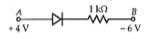
Consider the junction diode as ideal. The value of current flowing through $AB$ is 
Image
  • $10^{-2} A$
  • B
    $0 A$
  • C
    $10^{-1} A$
  • D
    $10^{-3} A$

Answer: A.

View full solution
What happens to fringe width in the Young's double slit experiment, if it is performed in glycerine instead of air?
  • A
    The fringes shrink
  • B
    The fringes disappear
  • C
    The fringes remain unchanged
  • D
    The fringes get enlarged
View full solution
The value of $1$ Bohr magneton is: $[$Given $h =6.62 \times 10^{-34} Js , e =1.6 \times 10^{-19} C$ and $m _{ e }=9.1 \times 10^{-31} \ kg ]$
  • A
    $7.27 \times 10^{-24} Am ^2$
  • $9.27 \times 10^{-24} Am ^2$
  • C
    $10.57 \times 10^{-24} Am ^2$
  • D
    $8.57 \times 10^{-24} Am ^2$

Answer: B.

View full solution
Assertion (A):  An alternating current of frequency 50 Hz becomes zero, 100 times in one second. 
Reason (R): Alternating current changes direction and becomes zero twice in a cycle.
  • A
    Both A and R are true and R is the correct explanation of A.
  • B
    Both A and R are true but R is not the correct explanation of A.
  • C
    A is true but R is false.
  • D
    A is false but R is true.
View full solution
Assertion (A): Interference pattern is made by using yellow light instead of red light, the fringes becomes narrower. 
Reason (R): In Young's double slit experiment, fringe width is given by $\beta=\frac{\lambda D }{ d }$.
  • A
    Both A and R are true and R is the correct explanation of A.
  • B
    Both A and R are true but R is not the correct explanation of A.
  • C
    A is true but R is false.
  • D
    A is false but R is true.
View full solution
Assertion (A): Positive charge always moves from a higher potential point to a lower potential point. 
Reason (R): Electric potential is a vector quantity.
  • A
    Both A and R are true and R is the correct explanation of A
  • B
    Both A and R are true but R is not the correct explanation of A.
  • C
    A is true but R is false.
  • D
    A is false but R is true.
View full solution
Assertion (A): The photoelectrons produced by a monochromatic light beam incident on a metal surface have a spread in their kinetic energies.
Reason (R): The energy of electrons emitted from inside the metal surface, is lost in collision with the other atoms in the metal.
  • A
    Both A and R are true and R is the correct explanation of A.
  • B
    Both A and R are true but R is not the correct explanation of A.
  • C
    A is true but R is false.
  • D
    A is false but R is true.
View full solution
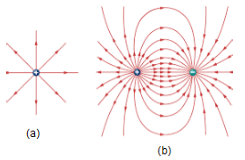
Depict the field-line pattern due to a current-carrying solenoid of finite length.
i. In what way do these lines differ from those due to an electric dipole?
ii. Why can't two magnetic field lines intersect each other?
View full solution
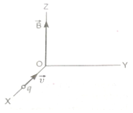
As shown in figure, a charge q moving along the X -axis with a velocity $\vec{v}$ is subjected to a uniform magnetic field $\vec{B}$ acting along the Z-axis as it crosses the origin O.
Image
i. Trace its trajectory.
ii. Does the charge gain kinetic energy, as it enters the magnetic field? Justify your answer.
View full solution
In the first excited state of the hydrogen atom, its radius is found to be $21.2 \times 10^{-11} m$. Calculate its Bohr radius in the ground state. Also, calculate the total energy of the atom in the second excited state.
View full solution
Draw the energy band diagram of (i) n-type, and (ii) p-type semiconductors at temperature T > 0 K. In the case of n-type Si-semiconductor, the donor energy level is slightly below the bottom of conduction band whereas in p-type semiconductor, the acceptor energy level is slightly above the top of valence band. Explain, giving examples, what role do these energy levels play in conduction and valence bands.
View full solution
A straight solenoid of length $50 \ cm$ has $1000$ turns and a mean cross$-$sectional area of $2 \times 10^{-4} m^2$. It is placed with its axis at $30^{\circ}$, with a uniform magnetic field of $0.32 T .$ Find the torque acting on the solenoid when a current of $2 A$ is passed through it.
View full solution
Q 153 Marks Question3 Marks
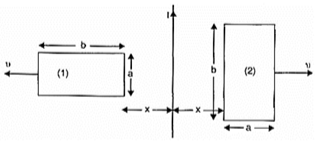
The figure shows two identical rectangular loops (1) and (2) placed on a table along with a straight long current carrying conductor between them.
i. What will be the directions of the induced current in the loops when they are pulled away from the conductor with same velocity v?
ii. Will the emf induced in the two loops be equal?
Image
View full solution
Q 163 Marks Question3 Marks
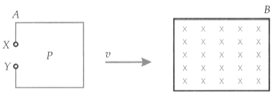
A rectangular coil P is moved from a point A to another point B with uniform velocity 'v' through a region of a uniform magnetic field acting normally inwards as shown in the figure. Show graphically (i) the variation of magnetic flux associated with the coil with time, (ii) the variation of induced emf across points X and Y of the coil with time. 
Image

Explain the nature of variation in magnetic flux as represented by the graph in the first case.
View full solution
Q 173 Marks Question3 Marks
How is the spacing between fringes in a double slit experiment affected if:
a. the slits separation is increased,
b. the colour of light used is changed from red to blue,
c. the whole apparatus is submerged in a oil of refractive index 1.2?
Justify your anwer in each case.
View full solution
Q 183 Marks Question3 Marks
Hydrogen atom in its ground state is excited by means of monochromatic radiation of wavelength $975 \stackrel{\circ}{A}$.
$i.$ How many different lines are possible in the resulting spectrum?
$ii.$ Calculate the longest wavelength amongst them. You may assume the ionization energy for hydrogen atom as $13.6 eV .$
View full solution
Q 193 Marks Question3 Marks
$i.$ Draw a plot showing the variation of potential energy of a pair of nucleons as a function of their separation. Mark the regions where the nuclear force is
$a.$ attractive and
$b.$ repulsive.
$ii.$ In the nuclear reaction ${ }_0 n^1+{ }_{92}^{235} U \rightarrow_{54}^a Xe +{ }_b^{94} Sr +2{ }_0 n^1$ determine the values of $a$ and $b.$
View full solution
$a$. Derive an expression for the impedance of a series $L-C-R$ circuit connected to an $AC$ supply of variable frequency.
$b$. Explain briefly how the phenomenon of resonance in the circuit can be used in the tuning mechanism of a radio or a $TV$ set?
View full solution
A series L-C-R circuit is connected to an AC source. Using the phasor diagram, derive the expression for the impedance of the circuit. Plot a graph to show the variation of current with frequency of the source, explaining the nature of its variation.
View full solution
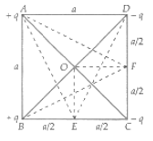
Four charges $+ q ,+ q ,- q$ and $- q$ are placed respectively at the corners $A , B , C$ and $D$ of a square of side a arranged in the given order. Calculate the electric potential at the centre $O$ . If A a $E$ and $F$ are the midpoints of sides $BC$ and $CD$ respectively, what will be the work done in carrying a charge e from $O$ to $E$ and from $O$ to $F$ ?
Image
View full solution
Find the expression for the energy stored in the capacitor. Also find the energy lost when the charged capacitor is disconnected from the source and connected in parallel with the uncharged capacitor. Where does this loss of energy appear?
View full solution
$i.$ There are two sets of apparatus of Young's double$-$slit experiment. Inset $A$, the phase difference between the two waves emanating from the slits does not change with time, whereas in set $B,$ the phase difference between the two waves from the slits changes rapidly with time. What difference will be observed in the pattern obtained on the screen in the two setups?
$ii.$ Deduce the expression for the resultant intensity in both the above$-$mentioned setups $( A$ and $B ),$ assuming that the waves emanating from the two slits have the same amplitude a and same wavelength $\lambda$.
View full solution
View full solution
View full solution

Generate a MODEL PAPER 10 paper free

Pick question groups from the list above, set marks and difficulty, and export a branded PDF with step-by-step answer keys. First 3 chapters free — no signup.
Download App