Question
A series L-C-R circuit is connected to an AC source. Using the phasor diagram, derive the expression for the impedance of the circuit. Plot a graph to show the variation of current with frequency of the source, explaining the nature of its variation.
Answer

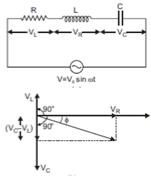
Suppose a resistance R , inductance L and capacitance C in series. An alternating source of voltage $V = V _{ o }$ sin $\omega t$ is applied across it. Since all the components are connected in series, the current flowing through all is same.
Voltage across resistance R is $V _{ R }$, voltage across inductance L is $V _{ L }$ and voltage across capacitance C is $V _{ C }$. 
$V _{ R }$ and $\left( V _{ C }- V _{ L }\right)$ are mutually perpendicular and the phase difference between them is $90^{\circ}$.
Image

From the figure above, we have 
$V^2=V_R^2+\left(V_C-V_L\right)^2 \Rightarrow V=\sqrt{V_R^2+\left(V_C-V_L\right)^2} \ldots \ldots$ (i)
and $V_R=R i, V_C=X_C i$ and $V_L=V_L i \ldots$. (ii)
where $X _{ C }=\frac{1}{\omega C}=$ capacitance reactance and $X _{ L }=\omega L=$ inductive reactance
$\therefore \quad V=\sqrt{(R i)^2+\left(X_C i-X_L i\right)^2}$
$\therefore$ Impendance of circuit, $Z=\frac{V}{i}=\sqrt{R^2+\left(X_C-X_L\right)^2}$
i.e. $Z=\sqrt{R^2+\left(X_C-X_L\right)^2}=\sqrt{R^2+\left(\frac{1}{\omega C}-\omega L\right)^2}$
The phase difference between current and voltage is given by, 
$\tan \phi=\frac{X_C-X_L}{R}$
Image

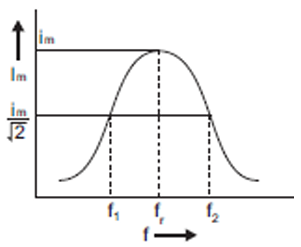
From the graph, we can see that with increase in frequency, current first increases and then decreases. At resonant frequency, current amplitude is maximum.

Need a full question paper?

Generate a complete, print-ready paper with questions like this in minutes — across 16+ boards, with answer keys.

Start Generating Free

Similar questions

Figure shows a small spherical ball of mass m rolling down the loop track. The ball is released on the linear portion at a vertical height H from the lowest point. The circular part shown has a radius R.
  1. Find the kinetic energy of the ball when it is at a point A where the radius makes an angle $\theta$ with the horizontal.
  2. Find the radial and the tangential accelerations of the centre when the ball is at A.
  3. Find the normal force and the frictional force acting on the ball if H = 60cm, R = 10cm, $\theta=0 $ and m = 70g.
The frequency of vibration of a string depends on the length L between the nodes, the tension F in the string and its mass per unit length m. Guess the expression for its frequency from dimensional analysis.
Three capacitors having capacitances $20\mu\text{F},\ 30\mu\text{F}$ and $40\mu\text{F}$ are connected in series with a 12V battery. Find the charge on each of the capacitors. How much work has been done by the battery in charging the capacitors?
$(I) (a)$ A giant refracting telescope at an observatory has an objective lens of focal length $15 m$. If an eyepiece of focal length $1.0 \ cm$ is used, what is angular magnification of the telescope in normal adjustment?
$(b)$ If this telescope is used to view the moon, what is the diameter of the image of the moon formed by the objective lens? The diameter of the moon is $3.48 \times 10^6 m$ and the radius of lunar orbit is $3.8 \times 10^8 m$.
A box weighing 2000N is to be slowly slid through 20m on a straight track having friction coefficient 0.2 with the box.
  1. Find the work done by the person pulling the box with a chain at an angle $\theta $ with the horizontal.
  2. Find the work when the person has chosen a value of $\theta $ which ensures him the minimum magnitude of the force.
$a$ . Derive an expression for the potential energy of an electric dipole in a uniform electric field. Explain conditions for stable and unstable equilibrium.
$b$ . Is the electrostatic potential necessarily zero at a point where the electric field is zero? Give an example to support your answer.
A man with normal near point (25 cm) reads a book with small print using a magnifying glass: a thin convex lens of focal length 5 cm.
  1. What is the closest and the farthest distance at which he should keep the lens from the page so that he can read the book when viewing through the magnifying glass?
  2. What is the maximum and the minimum angular magnification (magnifying power) possible using the above simple microscope?
The separation between the plates of a parallel$-$plate capacitor is $0.500\ cm$ and its plate area is $100\ cm^2.$ A $0.400\ cm$ thick metal plate is inserted into the gap with its faces parallel to the plates. Show that the capacitance of the assembly is independent of the position of the metal plate within the gap and find its value.
The half$-$life of $^{40}K$ is $1.30 \times 10^9y$. A sample of $1.00g$ of pure $\text{KCI}$ gives $160$ counts/ s. Calculate the relative abundance of $^{40}K\ ($fraction of $^{40}K$ present$)$ in natural potassium.
A small block of superdense material has a mass of $3 \times 10^{24}kg.$ It is situated at a height $h ($much smaller than the earth's radius$)$ from where it falls on the earth's surface. Find its speed when its height from the earth's surface has reduced to $\frac{\text{h}}{2}.$ The mass of the earth is $6 \times 10^{24}\ kg.$