Questions

5 Marks Questions

Take a timed test

6 questions · self-marked practice — reveal the answer and mark yourself.

Question 15 Marks
$a.$ Derive an expression for the impedance of a series ${L-C-R}$ circuit connected to an $AC$ supply of variable frequency.
$b.$ Explain briefly how the phenomenon of resonance in the circuit can be used in the tuning mechanism of a radio or a $TV$ set?
Answer
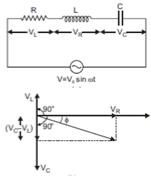
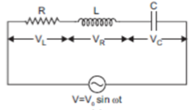
$a.$ Suppose a resistance $R$ , inductance $L$ and capacitance $C$ are connected to series and an alternating voltage $V =V=V_0$ sinut is applied across it.
Image
Since $L, C$ and $R$ are connected in series, current flowing through them is the same. The voltage across $R$ is $V_R$, inductance across L is $V _{ L }$ and across capacitance is $V _{ C }$.
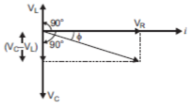
The voltage $V_R$ and current $i$ are in the same phase, the voltage $V_L$ will lead the current by angle $90^{\circ}$ while the voltage $V_C$ will lag behind the current by $90^{\circ}$.
Image
Thus, $V _{ R }$ and $\left( V _{ C }- V _{ L }\right)$ are mutually perpendicular and the phase difference between them is $90^{\circ}$. As seen in the fig, we can say that, as the applied voltage across the circuit is $V$, the resultant of $V_R$ and $V_C=V_L$ ) will also be $V$.
So,
$V^2=V_R^2+\left(V_c-V_L\right)^2$
$\Rightarrow V=\sqrt{V_R^2+\left(V_c-V_L\right)^2}$
But, $V _{ R }= Ri , V _{ c }= X _{ c } i$ and $V _{ L }= X _{ L } i$
where, $X _{ c }=\frac{1}{\omega C}$ and $X _{ L }=\omega L$
Therefore, impendance of the circuit is given by,
$ Z =\frac{V}{i}=\sqrt{(R)^2+\left(X_c-X_L\right)^2}$
$Z =\sqrt{R^2+\left(\frac{1}{\omega C}-\omega L\right)^2}$
This is the impedance of the $\text{LCR}$ series circuit.
$b.$ A radio or a $TV$ set has an $LC$ circuit capacitor of variable capacitance $C$. The circuit remains connected with an aerial coil through the phenomenon of mutual inductance. Suppose a radio or $TV$ station has transmitted a program at frequency $f$ , then waves produce an alternating voltage of frequency in area, due to which an emf of the same frequency is induced in $LC$ circuit. When capacitor $C$ is in circuit is varied then for a particular value of capacitance, $C, f=\frac{1}{2 \pi \sqrt{L C}}$, the resonance occurs and maximum current flows in the circuit; so the radio or $TV$ gets tuned.
 
View full question & answer
Question 25 Marks
$i$. Derive lens maker’s formula for a biconvex lens.
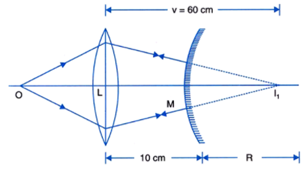
$ii$. A point object is placed at a distance of $12 \ cm$ on the principal axis of a convex lens of focal length $10 \ cm$. A convex mirror is placed coaxially on the other side of the lens at a distance of $10 \ cm$. If the final image coincides with the object, sketch the ray diagram, and find the focal length of the convex mirror.
Answer
$i.$
Image
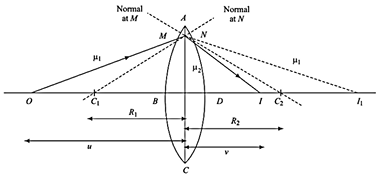
The complete derivation of the lens maker formula is described below.
For refraction at surface $\text{ABC},$ we have
$\frac{\mu_2}{v_1}-\frac{\mu_1}{u}=\frac{\mu_2-\mu_1}{R_1} \ldots (i) $
$\ ($Here $\mu_2, \mu_1$ are the refractive index of the material$)$
For refraction at surface $\text{ADC},$ we have
$\frac{\mu_1}{v}-\frac{\mu_2}{v_1}=\frac{\mu_1-\mu_2}{R_2} \ldots (ii)$
Adding equation $(i)$ and $(ii),$ we get
$\frac{\mu_1}{v}-\frac{\mu_1}{u}=\left(\mu_2-\mu_1\right)\left[\frac{1}{R_1}-\frac{1}{R_2}\right]$
$\frac{1}{v}-\frac{1}{u}=\left[\frac{\left(\mu_2-\mu_1\right)}{\mu_1}\right]\left[\frac{1}{R_1}-\frac{1}{R_2}\right] \ldots (iii)$
If the object is placed at infinity $(u= ),$ the image will be formed at the focus, i.e. $v = f$
Therefore
$\frac{1}{f}-\frac{1}{\infty}=\left(\mu_{21}-1\right)\left[\frac{1}{R_1}-\frac{1}{R_2}\right]$
From eq. $(iii)$ and $(iv),$ we have
$\frac{1}{v}-\frac{1}{u}=\frac{1}{f}$
This is Lens maker formula.
ii. For refraction at convex lens, we have

Image

Object distance $, u =-12 \ cm$
Image distance $, v =$ ?
Forcal length, $f =+10 \ cm$
Using lens formula, we have
$\frac{1}{v}-\frac{1}{(-12)}=\frac{1}{10}$
i.e. $v = + 60 \ cm$
Thus, in the absence of a convex mirror, the convex lens will form the image $I _1$, at a distance of $60 \ cm$ behind the lens.
As the mirror is at a distance of $10 \ cm$ from the lens, image $I _1$ will be at a distance of $(60-10)=50 \ cm$ from the mirror, i.e., $MI _1=50 \ cm.$
Now, as the final image $I_2$ is formed at the object itself, the rays after reflection from the mirror retrace its path,
i.e., the rays on the mirror are incident normally, i.e., $I _1$ is the centre of the mirror so that
$ R = MI _1=+50 \ cm$
and $f =\frac{R}{2}=\frac{50}{2}$
​​​​​​​$=25 \ cm$
Which is the focal length of the mirror.
View full question & answer
Question 35 Marks
A series L-C-R circuit is connected to an AC source. Using the phasor diagram, derive the expression for the impedance of the circuit. Plot a graph to show the variation of current with frequency of the source, explaining the nature of its variation.
Answer
Suppose a resistance R , inductance L and capacitance C in series. An alternating source of voltage $V = V _{ o }$ sin $\omega t$ is applied across it. Since all the components are connected in series, the current flowing through all is same.
Voltage across resistance R is $V _{ R }$, voltage across inductance L is $V _{ L }$ and voltage across capacitance C is $V _{ C }$. 
$V _{ R }$ and $\left( V _{ C }- V _{ L }\right)$ are mutually perpendicular and the phase difference between them is $90^{\circ}$.
Image

From the figure above, we have 
$V^2=V_R^2+\left(V_C-V_L\right)^2 \Rightarrow V=\sqrt{V_R^2+\left(V_C-V_L\right)^2} \ldots \ldots$ (i)
and $V_R=R i, V_C=X_C i$ and $V_L=V_L i \ldots$. (ii)
where $X _{ C }=\frac{1}{\omega C}=$ capacitance reactance and $X _{ L }=\omega L=$ inductive reactance
$\therefore \quad V=\sqrt{(R i)^2+\left(X_C i-X_L i\right)^2}$
$\therefore$ Impendance of circuit, $Z=\frac{V}{i}=\sqrt{R^2+\left(X_C-X_L\right)^2}$
i.e. $Z=\sqrt{R^2+\left(X_C-X_L\right)^2}=\sqrt{R^2+\left(\frac{1}{\omega C}-\omega L\right)^2}$
The phase difference between current and voltage is given by, 
$\tan \phi=\frac{X_C-X_L}{R}$
Image

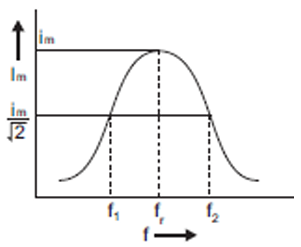
From the graph, we can see that with increase in frequency, current first increases and then decreases. At resonant frequency, current amplitude is maximum.
View full question & answer
Question 45 Marks
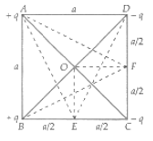
Four charges $+ q ,+ q ,- q$ and $- q$ are placed respectively at the corners $A , B , C$ and $D$ of a square of side a arranged in the given order. Calculate the electric potential at the centre $O$ . If $A$ a $E$ and $F$ are the midpoints of sides $BC$ and $CD$ respectively, what will be the work done in carrying a charge e from $O$ to $E$ and from $O$ to $F$ ?
Image
Answer
Let $OA = OB = OC = OD = r$
Then the potential at the centre $O$ is
$V_O=\frac{1}{4 \pi \varepsilon_0}\left[\frac{q}{r}+\frac{q}{r}-\frac{q}{r}-\frac{q}{r}\right]=0$
Again, the potential at point $E$ is
$V_E=\frac{1}{4 \pi \varepsilon_0}\left[\frac{q}{A E}+\frac{q}{B E}-\frac{q}{C E}-\frac{q}{D E}\right]=0$
$[\therefore AE = DE , BE = CE ]$
Now, $A F=B F=\sqrt{a^2+\left(\frac{a}{2}\right)^2}=\frac{\sqrt{5} a}{2}$
$\therefore$ The potential at point $F$ is
$V_F=\frac{1}{4 \pi \varepsilon_0}\left[\frac{q}{A F}+\frac{q}{B F}-\frac{q}{C F}-\frac{q}{D F}\right]$
$=\frac{2 q}{4 \pi \varepsilon_0}\left[\frac{1}{A F}-\frac{1}{C F}\right][\because AF = BF , CF = DF ]$
$=\frac{2 q}{4 \pi \varepsilon_0}\left[\frac{2}{\sqrt{5} a}-\frac{2}{a}\right]=\frac{q}{\pi \varepsilon_0 a}\left(\frac{1}{\sqrt{5}}-1\right)$
Work done in moving the charge $V$ from $O$ to $E$ is
$W = e \left[ V _{ E }- V _{ O }\right]= e \times 0=0$
Work done in moving the charge $'e\ '$ from $O$ to $F$ is
$W=e\left[V_F-V_O\right]$
$=e\left[\frac{q}{\pi \varepsilon_0 a}\left(\frac{1}{\sqrt{5}}-1\right)-0\right]$
$=\frac{q e}{\pi \varepsilon_0 a}\left(\frac{1}{\sqrt{5}}-1\right)$
View full question & answer
Question 55 Marks
Find the expression for the energy stored in the capacitor. Also find the energy lost when the charged capacitor is disconnected from the source and connected in parallel with the uncharged capacitor. Where does this loss of energy appear?
Answer
$Q=Q_1+Q_2$
$V _1= V _2$ potential of both capacitors after they are connected with each other.
$\therefore \frac{Q_1}{C_1}=\frac{Q_2}{C_2} $
$\Rightarrow Q=\left(\frac{C_1}{C_2}+1\right) Q_2$
$Q_2=\frac{Q C_2}{C_1+C_2} Q_1=\frac{Q C_1}{C_1+C_2}$
$V_2= V _1=\frac{Q}{C_1+C_2}=\frac{Q_2}{C_2}=\frac{Q_1}{C_1}$
$ U _{ f }=\frac{1}{2} C_1 V_1^2+\frac{1}{2} C_2 V_2^2$
$=\frac{1}{2}\left(C_1+C_2\right) \frac{Q^2}{\left(C_1+C_2\right)^2}=\frac{Q^2}{2\left(C_1+C_2\right)}$
$U_i=\frac{Q^2}{2 C_1}$
$U_i-U_f=\frac{Q^2}{2 C_1}-\frac{Q^2}{2\left(C_1+C_2\right)}$
$=\frac{Q^2\left(C_2\right)}{\left(C_1\right)\left(C_1+C_2\right)}$
The lost energy appears in the form of heat.
View full question & answer
Question 65 Marks
$i$. There are two sets of apparatus of Young's double-slit experiment. Inset $A,$ the phase difference between the two waves emanating from the slits does not change with time, whereas in set $B,$ the phase difference between the two waves from the slits changes rapidly with time. What difference will be observed in the pattern obtained on the screen in the two setups?
$ii$. Deduce the expression for the resultant intensity in both the above $-$ mentioned setups $( A$ and $B ),$ assuming that the waves emanating from the two slits have the same amplitude a and same wavelength $\lambda$.
Answer
$i.$ There are two sets of apparatus of Young's double-slit experiment.
In Set $A$: Stable interference pattern, the positions of maxima and minima do not change with time.
In Set $B$: Positions of maxima and minima will change rapidly with time and an average uniform intensity distribution will be observed on the screen.
$ii$. Expression for the intensity of stable interference pattern in set $-A$
If the displacement produced by slit $S_1$ is given by
$y _1= a \cos \omega t$
then, the displacement produced by $S _2$ would be
$y_2=\operatorname{a \cos}(\omega t+\phi)$
and the resultant displacement will be given by
$y=y_1+y_2$
$=a [ \cos \omega t+\cos (\omega t+\phi)]$
$=2 a \cos \left(\frac{\phi}{2}\right) \cos \left(\omega t+\frac{\phi}{2}\right)$
The amplitude of the resultant displacement is $2 \operatorname{a \cos}\left(\frac{\phi}{2}\right)$ and therefore the intensity at that point will be
$ I =4 I _0 \cos ^2\left(\frac{\phi}{2}\right)$
$\phi=0$
$\therefore I =4 I _0$
In set $B,$ the intensity will be given by the average intensity is given by : $-$ 
$ I =4 I _0 \cos ^2\left(\frac{\phi}{2}\right)$
$I =2 I _0$
View full question & answer