Question
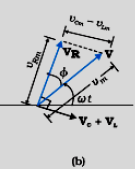
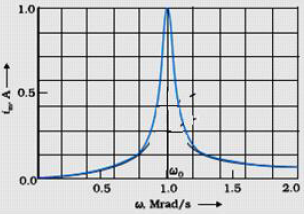
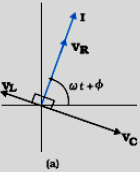
A series LCR circuit is connected to an ac source. Using the phasor diagram, derive the expression for the impedance of the circuit. Plot a graph to show the variation of current with frequency of the source, explaining the nature of its variation.

Answer


Resultant potential across LCR

$\text{V}^{2} = \text{V}^{2}_{\text{R}} + (\text{V}_{L} - \text{V}_{c} ) ^{2}$

$\text{V}_{R} = \text{iR},\text{V}_{L} = \text{i}\text{X}_{L},\text{V}_\text{c} = \text{i X}_{c}$

On solving

$\text{Z} = \sqrt{\text{R}^{2} + (\text{X}_{L} - \text{X}_{C})^{2}}$


With increase in ω, current first increases (up to ωo ) and then decreases.

Need a full question paper?

Generate a complete, print-ready paper with questions like this in minutes — across 16+ boards, with answer keys.

Start Generating Free

Similar questions

Let $\varepsilon_1$ and $\varepsilon_2$ be the angles made by $\overrightarrow{\text{A}}$ and $-\overrightarrow{\text{A}}$ with the positive X-axis. Show that $\tan\varepsilon_1=\tan\varepsilon_2.$ Thus, giving tane does not uniquely determine the direction of $\overrightarrow{\text{A}}.$
A piece of wire carrying a current of 6.00A is bent in the form of a circular arc of radius 10.0cm, and it subtends an angle of 120° at the centre. Find the magnetic field B due to this piece of wire at the centre.
A person travels on a spaceship moving at a speed of $\frac{5\text{c}}{13}$
  1. Find the time interval calculated by him between the consecutive birthday celebrations of his friend on the earth.
  2. Find the time interval calculated by the friend on the earth between the consecutive birthday celebrations of the traveller.
When 1.0 × 10¹² electrons are transferred from one conductor to another, a potential difference of 10V appears between the conductors. Calculate the capacitance of the two-conductor system.
The ground state energy of hydrogen atom is – 13.6 eV. If an electron makes a transition from an energy level – 0.85 eV to – 3.4 eV, calculate the wavelength of the spectral line emitted.To which series of hydrogen spectrum does this wave length belong?
Get the total electric flux associated with a closed cylinder placed in a uniform electric field.
(a) What happens if a bar magnet is cut into two pieces: (i) transverse to its length, (ii) along its length?
(b) A magnetised needle in a uniform magnetic field experiences a torque but no net force. An iron nail near a bar magnet, however, experiences a force of attraction in addition to a torque. Why?
(c) Must every magnetic configuration have a north pole and a south pole? What about the field due to a toroid?
(d) Two identical looking iron bars A and B are given, one of which is definitely known to be magnetised. (We do not know which one.) How would one ascertain whether or not both are magnetised? If only one is magnetised, how does one ascertain which one? [Use nothing else but the bars A and B.]
An $\alpha$-particle collides with nucleus after passing through the potential V volt. Prove that distance of closest approach of particle of atomic number $Z$ to the nucleus will be $14.4( Z / V ) \ Å$.
(Given that : $1 / 4 \pi \varepsilon_0=9.0 \times 10^9$ Newton-meter $^2 /$ Coulomb $^2$ and $e=1.6 \times 10^{-19}$ Coulomb)
  1. Three photo diodes D1 , D2 and D3 are made of semiconductors having band gaps of 2.5eV, 2eV and 3eV respectively. Which of them will not be able to detect light of wavelength 600nm?
  2. Why photodiodes are required to operate in reverse bias? Explain.
In Young’s double slit experiment, the two slits are separated by a distance of 1·5 mm and the screen is placed 1 m away from the plane of the slits. A beam of light consisting of two wavelengths 650 nm and 520 nm is used to obtain interference fringes. Find.
  1. The distance of the third bright fringe for$\lambda = 520$ nm on the screen from the central maximum.
  2. The least distance from the central maximum where the bright fringes due to both the wavelengths coincide.