Question
An $\alpha$-particle collides with nucleus after passing through the potential V volt. Prove that distance of closest approach of particle of atomic number $Z$ to the nucleus will be $14.4( Z / V ) \ Å$.
(Given that : $1 / 4 \pi \varepsilon_0=9.0 \times 10^9$ Newton-meter $^2 /$ Coulomb $^2$ and $e=1.6 \times 10^{-19}$ Coulomb)
Answer

Energy of the $\alpha$-particle to reach the closest to the nucleus :
Kinetic energy of $\alpha$-particle $=$ Electrostatic potential energy of $\alpha$-particle and nucleus system.
$\begin{array}{l}
2 e \times V=\frac{1}{4 \pi \in_0}\left(\frac{2 e \times Z e }{r_0}\right)=9 \times 10^9\left(\frac{2 e \times Z e }{r_0}\right) \\
\begin{array}{l}
\Rightarrow 2 eV=\frac{2 \times 9 \times 10^9 \times Z e^2}{r_0} \Rightarrow r_0=\frac{9 \times 10^9 \times Z e }{V} \text { meter } \\
\text { Putting the values }=9 \times 10^9 \times 1.6 \times 10^{-19}\left(\frac{Z}{V}\right) \text { meter } \\
=14.4 \times 10^{-10}\left(\frac{Z}{V}\right) \text { meter } \\
=\left[14.4\left(\frac{Z}{V}\right)\right] \ Å\end{array}\end{array}$

Need a full question paper?

Generate a complete, print-ready paper with questions like this in minutes — across 16+ boards, with answer keys.

Start Generating Free

Similar questions

An electron and a photon each have a wavelength 1.00 nm. Find.
  1. Their momenta,
  2. The energy of the photon and,
  3. The kinetic energy of electron.
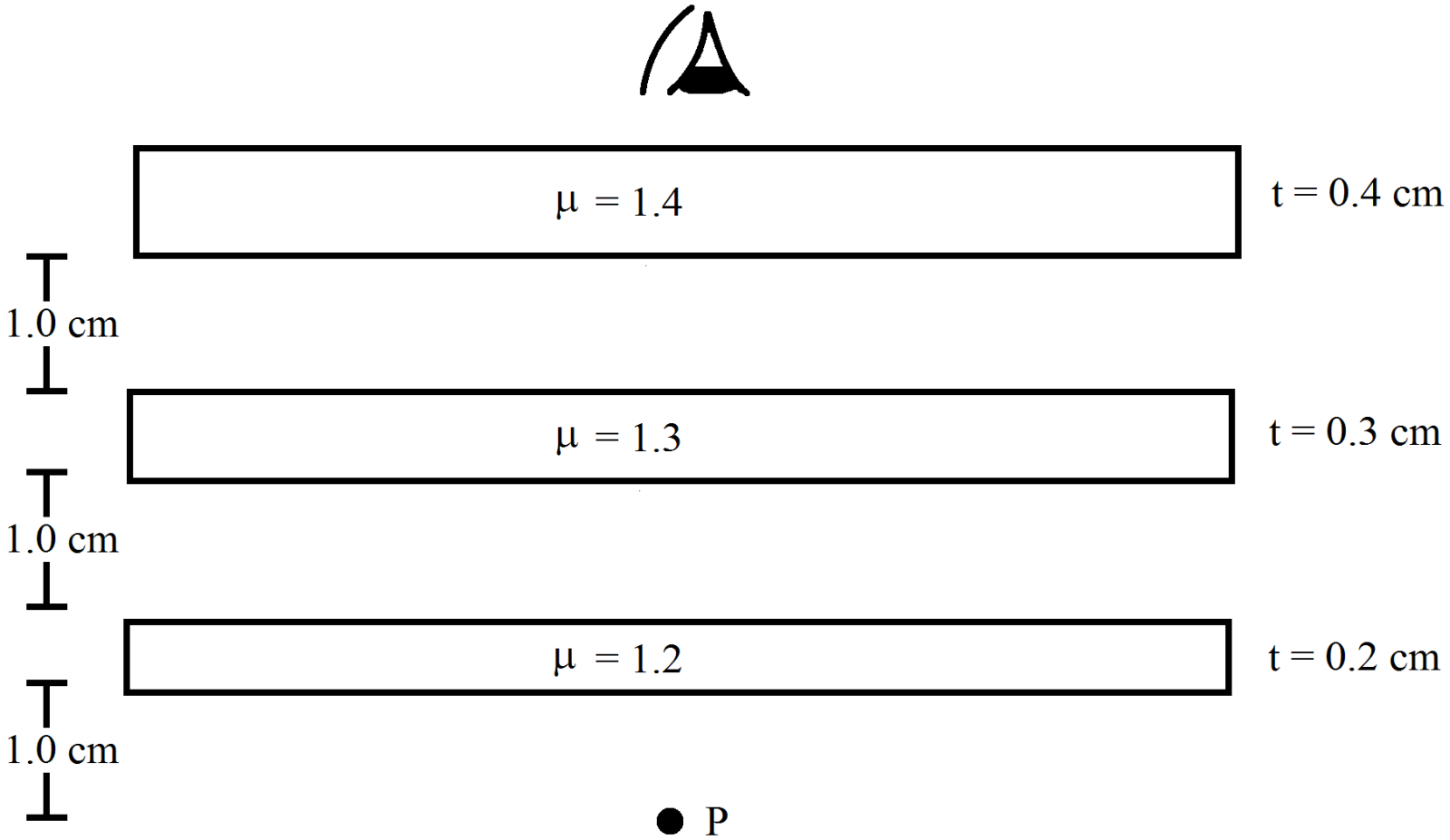
Locate the image of the point P as seen by the eye in the figure.

Find the energy liberated in the reaction:
223Ra → 209Pb + 14C.
The atomic masses needed are as follows.
223Ra 209Pb 14C
22.018u 208.981u 14.003u
In a Quincke's experiment, the sound intensity has a minimum value I at a particular position. As the sliding tube is pulled out by a distance of 16.5mm, the intensity increases to a maximum of 9I. Take the speed of sound in air to be 330m/s.
  1. Find the frequency of the sound source.
  2. Find the ratio of the amplitudes of the two waves arriving at the detector assuming that it does not change much between the positions of minimum intensity and maximum intensity.
A monkey is climbing on a rope that goes over a smooth light pulley and supports a block of equal mass at the other end figure. Show that whatever force the monkey exerts on the rope, the monkey and the blockmove in the same direction with equal acceleration. If initially both were at rest, their separation will not change as time passes.

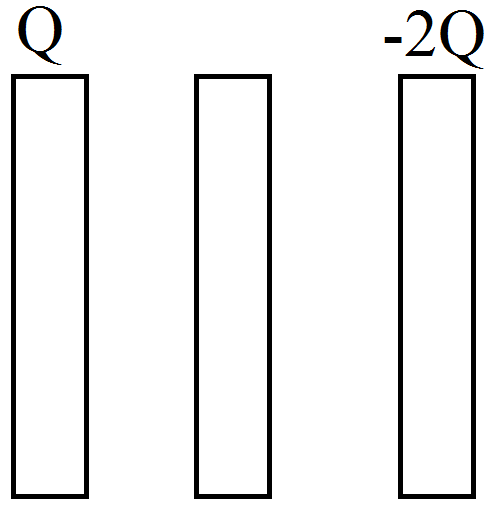
Three identical metal plates with large surface areas are kept parallel to each other as shown in figure. The leftmost plate is given a charge Q, the rightmost a charge -2Q and the middle one remains neutral. Find the charge appearing on the outer surface of the rightmost plate.

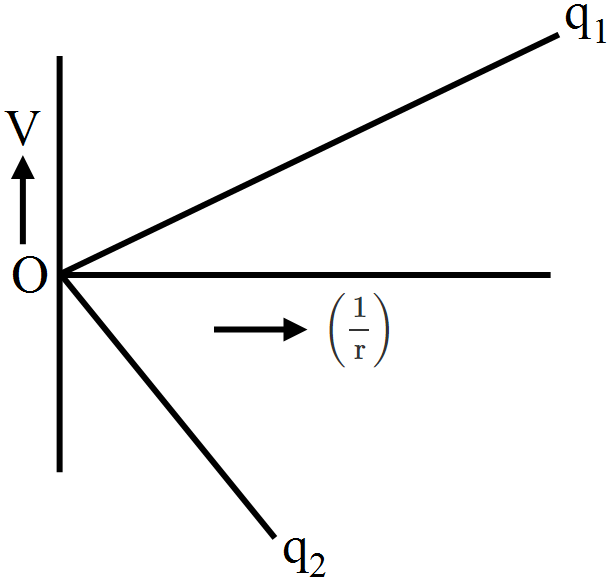
The two graphs are drawn below, show the variations of electrostatic potential (V) $\frac{1}{\text{r}}$ (r being the distance of field point from the point charge) for two point charges q1 and q2.
  1. What are the signs of the two charges?
  2. Which of the two charges has the larger magnitude and why?
​​​​​​​​​​​​​​
Should the energy of a photon be called its kinetic energy or its internal energy?
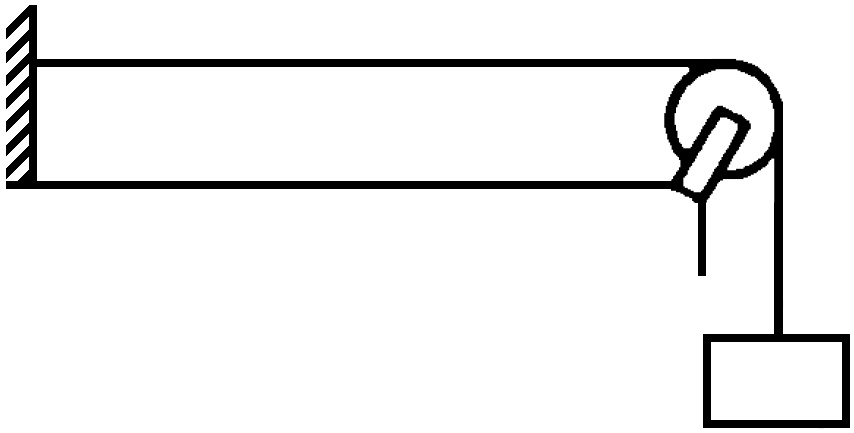
Figure, shows a string stretched by a block going over a pulley. The string vibrates in its tenth harmonic in unison with a particular tuning fork. When a beaker containing water is brought under the block so that the block is completely dipped into the beaker, the string vibrates in its eleventh harmonic. Find the density of the material of the block.

Two charge $5 \times 10^{-8} C$ and $-3 \times 10^{-8} C$ are located 20 cm apart. At what points(s) on the line joining the two charges is the electric potential zero? Take the potential at infinity to be zero.