MCQ
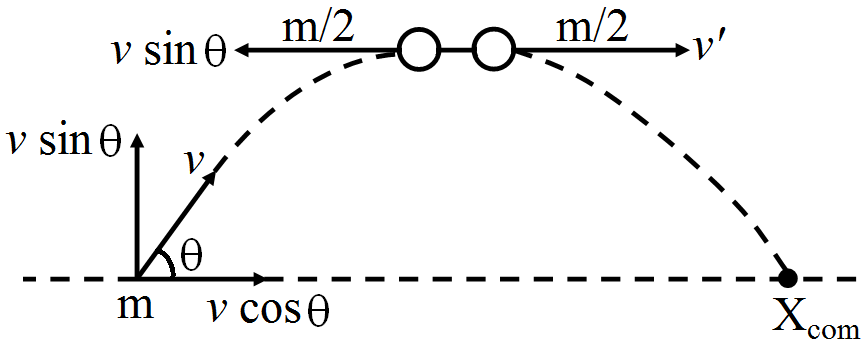
A shell is fired from a cannon with a velocity V at an angle $\theta$ with the horizontal direction. At the highest point in its path, it explodes into two pieces of equal masses. One of the pieces retraces its path to the cannon. The speed of the other piece immediately after the explosion is:
  • $\text{3V}\cos\theta$
  • B
    $2\text{V}\cos\theta$
  • C
    $\frac{3}{2}\text{V}\cos\theta$
  • D
    $\text{V}\cos\theta$

Answer

Correct option: A.
$\text{3V}\cos\theta$
Explanation:

The linear momentum is conserved in horizontal direction.


Initial momentum = Final momentum

$\Rightarrow\text{mv}\cos\theta=-\frac{\text{m}}{2}\text{v}\cos\theta+\frac{\text{m}}{2}\text{v}'$

$\Rightarrow\text{v}'=\text{mv}\cos\theta$

Need a full question paper?

Generate a complete, print-ready paper with questions like this in minutes — across 16+ boards, with answer keys.

Start Generating Free

Similar questions

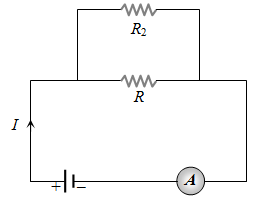
If a resistance $R_2$ is connected in parallel with the resistance R in the circuit shown, then possible value of current through R and the possible value of $R_2$ will be
Light wave propogates rectilinearly, due to
At the magnetic poles of the earth, a compass needle will be
In $YDSE$ experiment, when two light rays make third minima, then they have
A piece of fuse wire melts when a current of $15\, ampere$ flows through it. With this current, if it dissipates $22.5\, W$, the resistance of fuse wire will be .............. $\Omega$
The given figure shows, two parallel plates $A$ and $B$ of charge densities $+\sigma$ and $-\sigma$ respectively. Electric intensity will be zero in region
Material $A$ has critical angle $i_A$, and material $B$ has critical angle $i_B\left(i_B>i_A\right)$. Then which of the following is true
(i) Light can be totally internally reflected when it passes from $B$ to $A$
(ii) Light can be totally internally reflected when it passes from $A$ to $B$
(iii) Critical angle for total internal reflection is $i _{ B }- i _{ A }$
(iv) Critical angle between $A$ and $B$ is $\sin ^{-1}\left(\frac{\sin ^A A}{\sin _{ A }}\right)$
The electric potential (V) inside a uniformly charged. spherical shell depends on distance:
In a common base amplifier circuit, calculate the change in base current if that in the emitter current is $2\, mA$ and $\alpha = 0.98$.......$mA$
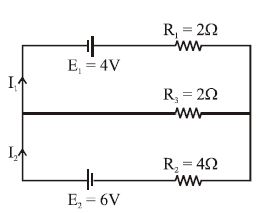
In the circuit shown below $E_1\, =4.0\, V$, $R_1\, = 2\,\Omega$, $E_2\, = 6.0\, V$, $R_2\, = 4\,\Omega$ and $R_3\, = 2\,\Omega$. The current $I_1$ is ............... $\mathrm{A}$