MCQ
In $YDSE$ experiment, when two light rays make third minima, then they have
  • A
    Phase difference of $3\pi $
  • B
    Phase difference of $\frac {5\pi }{2}$
  • C
    Path difference of $3\lambda $
  • Phase difference of $\frac {5\lambda  }{2}$

Answer

Correct option: D.
Phase difference of $\frac {5\lambda  }{2}$
d
For minima, path difference $\Delta=(2 n-1) \frac{\lambda}{2}$

For third minima $n=3 \Rightarrow \Delta=(2 \times 3-1) \frac{\lambda}{2}=\frac{5 \lambda}{2}$

Need a full question paper?

Generate a complete, print-ready paper with questions like this in minutes — across 16+ boards, with answer keys.
Start Generating Free

Similar questions

An electric heater consists of a nichrome coil and runs under $220 \,V$, consuming $1 \,kW$ power. Part of its coil burned out and it was reconnected after cutting off the burnt portion.The power it will cunsume now is
An inductor $20 \,\,mH,$ a capacitor $50\,\, \mu  F$ and a resistor $40 \,\,\Omega$ are connected in series across a source of emf $V = 10 \,sin \,340t.$ The power loss in A.C. circuit is......$ W$
If $\lambda_1$ and $\lambda_2$ are the wavelengths of characteristic X-rays and gamma rays respectively, then the relation between them is
Forty electric bulbs are connected in series across a 220 V supply. After one bulb is fused, the remaining 39 are connected again in series across the same supply. The illumination will be
The volume occupied by an atom is greater than the volume of the nucleus by a factor of about
Atomic weight of boron is $10.81$ and it has two isotopes $_5{B^{10}}$ and $_5{B^{11}}$. Then ratio of  $ _5{B^{10}}{\,:\,_5}{B^{11}} $ in nature would be
The first member of the Balmer series of hydrogen atom has a wavelength of $6561\; \mathring A$. The wavelength of the second member of the Balmer series (in $nm$) is
Two cells of same emf but different internal resistances $I_{1}$ and $I_{2}$ are connected in series with a resistance $R$. The value of resistance $R$, for which the potential difference across second cell is zero, is
An astronaut in a spaceship see the outer space as
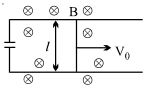
Two infinitely long conducting parallel rails are connected through a capacitor $C$ as shown in the figure. $A$ conductor of length $l$ is moved with constant speed $v_0$.Which of the following graph truly depicts the variation of current through the conductor with time ?