Question
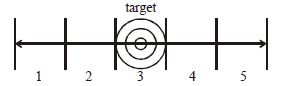
A shooting game involves using a gun that fires by itself at random times. The player can only point the gun in a fixed direction while the target moves from side to side with simple harmonic motion, as shown. At which of the given region should the player aim in order to score the greatest number of hits? 
Answer

During $SHM$ speed will be minimum in $1$ and $5$ region.
Hence probability of greatest number of hit will increase.

Need a full question paper?

Generate a complete, print-ready paper with questions like this in minutes — across 16+ boards, with answer keys.

Start Generating Free

Similar questions

The temperature of sink of Carnot engine is ${27^o}C$. Efficiency of engine is $25\%.$ Then temperature of source is ...... $^oC$
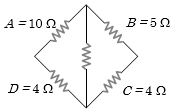
In a typical Wheatstone network, the resistances in cyclic order are $A = 10 \,\Omega $, $B = 5 \,\Omega $, $C = 4 \,\Omega $ and $D = 4 \,\Omega $ for the bridge to be balanced
An optical bench has $1.5 m$ long scale having four equal divisions in each $cm$. While measuring the focal length of a convex lens, the lens is kept at $75 cm$ mark of the scale and the object pin is kept at $45 cm$ mark. The image of the object pin on the other side of the lens overlaps with image pin that is kept at $135 cm$ mark. In this experiment, the percentage error in the measurement of the focal length of the lens is. . . . .
Water rises to a height of $16.3 \,cm$ in a capillary of height $18 \,cm$ above the water level. If the tube is cut at a height of $12\, cm$
A resistor develops $500\, J$ of thermal energy in $20 \,s$ when a current of $1.5\, A$ is passed through it. If the current is increased from $1.5 \,A$ to $3\, A$ what will be the energy (in $J$) developed in $20\, s$.
Meteors are
The ratio of the coefficient of volume expansion of a glass container to that of a viscous liquid kept inside the container is $1 : 4$. What fraction of the inner volume of the container should the liquid occupy so that the volume of the remaining vacant space will be same at all temperatures ?
What will be the colour of sky as seen from the earth, if there were no atmosphere
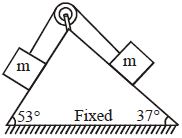
Two blocks which are connected to each other by means of a massless string are placed  on two inclined planes as shown in figure. After releasing from rest, the magnitude of  acceleration of the centre of mass of both the blocks is $(g = 10\, m/s^2)$
A series $L-R$ circuit is connected to a battery of emf $V$. If the circuit is switched on at $t =0$, then the time at which the energy stored in the inductor reaches $\left(\frac{1}{n}\right)$ times of its maximum value, is