MCQ
A short sighted person can see distinctly only those objects which lie between $10\, cm$ and $100\, cm$ from him. The power of the spectacle lens required to see a distant object is
  • A
    $+ 0.5\,D$
  • $-1.0\, D$
  • C
    $-10\,D$
  • D
    $+ 4.0\, D$

Answer

Correct option: B.
$-1.0\, D$
b
(b) $f = - \;d = - \;100\;cm = - \;1\;m$
$\therefore P = \frac{1}{f} = \frac{1}{{ - 1}} = - \;1\;D$

Need a full question paper?

Generate a complete, print-ready paper with questions like this in minutes — across 16+ boards, with answer keys.

Start Generating Free

Similar questions

Assertion : Ohm's law is applicable for all conducting elements.

Reason : Ohm's law is a fundamental law
Light of frequency $1.5$ times the threshold frequency Is incident on a photosensitive material. What will be the photoelectric current if the frequency is halved and intensity is doubled$?$
Which is a wrong statement
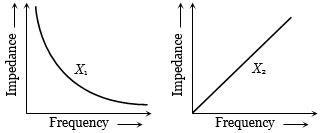
The graphs given below depict the dependence of two reactive impedances $X_1$ and $X_2$ on the frequency of the alternating e.m.f. applied individually to them. We can then say that
On a long horizontal belt, a child runs to and fro with a speed of $9\,km/h$ (with respect to the belt) between his father and mother located $50\,m$ apart on the moving belt. The belt moves with a speed of $4\,km/h.$ For an observer on the platform the speed of the child in the direction of motion of the belt is.........$km/h$
A force $F = Be^{-Ct}$ acts on a particle whose mass is $m$ and whose velocity is $0$ at $t = 0$. It’s terminal velocity is :
According to the kinetic theory of gases, at absolute temperature
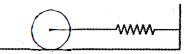
A uniform solid cylinder of mass $M = 3\  kg$ and radius $R = 10\  cm$ is connected about an axis through the cnetre of the cylinder to a horizontal spring with spring constant $8\ N/m$.The cylinder is pulled back, stretching the spring $1\,m$ from equilibrium.When released, the cylinder rolls without slipping. What is the speed of the center of th ecylinder when it returns to equilibrium? .................. $m/s$
A load $W$ produces an extension of $1mm$ in a thread of radius $r.$ Now if the load is made $4W$ and radius is made $2r$ all other things remaining same, the extension will become..... $mm$
When $X-$ rays pass through a strong uniform magnetic field, Then they