Question
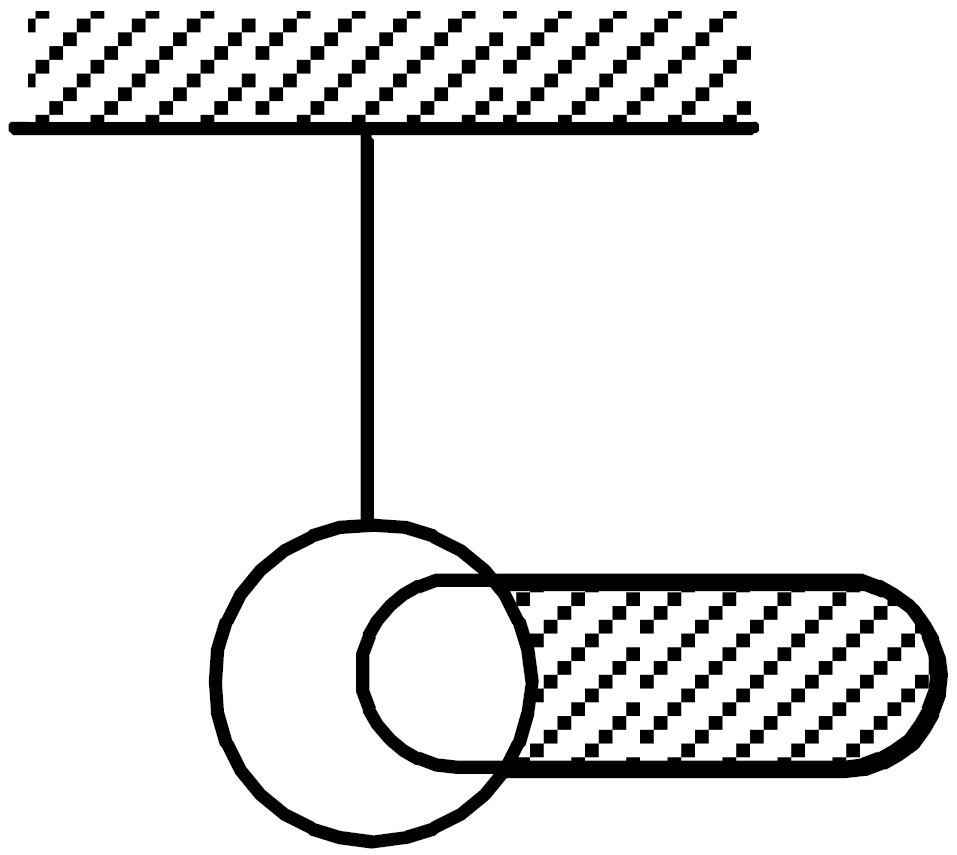
A silver ball of radius 4.8cm is suspended by a thread in a vacuum chamber. Ultraviolet light of wavelength 200 run is incident on the ball for some time during which a total light energy of $1.0 \times 10^{-7} \mathrm{~J}$ falls on the surface. Assuming that on the average one photon out of every ten thousand is able to eject a photoelectron, find the electric potential et the surface of the bell assuming zero potential at infinity. What is the potential at the centre of the bell?
Answer

$\lambda=200\text{nm}=2\times10^{-7}\text{m}$E of one photon $=\frac{\text{hc}}{\lambda}$
$=\frac{6.63\times10^{-34}\times3\times10\times^{8}}{2\times10^{-7}}=9.945\times10^{-19}$
No. of photons
$=\frac{1\times10^{-7}}{9.945\times10^{-19}}=1\times10^{11}\text{no.s}$
Hence, No.of photo electrons
$=\frac{1\times10^{11}}{10^{4}}=1\times10^{7}$
Net amount of positive charge ‘q’ developed due to the outgoing electrons
$=1 \times 10^7 \times 1.6 \times 10^{-19}=1.6 \times 10^{-12} \mathrm{C}$.
Now potential developed at the centre as well as at the surface due to these charger
$=\frac{\text{kq}}{\text{r}}=\frac{9\times10\times1.6\times10^{-12}}{4.8\times10^{-2}}=3\times10^{-1}\text{v}=0.3\text{v.}$

Need a full question paper?

Generate a complete, print-ready paper with questions like this in minutes — across 16+ boards, with answer keys.

Start Generating Free

Similar questions

Suppose the density of air at Madras is $\mathrm{P}_0$ and atomospheric pressure is $\mathrm{P}_0$. If we go up, the density and the pressure both decrease. Suppose we wish to calculate the pressure at a height 10 km above Madras. If we use the equation $\mathrm{P}_0$ - $\mathrm{P}=$ pogz, will we get a pressure more than the actual or less than the actual? Neglect the variation in g. Does your answer change if you also consider the variation in g?
When we rub our hands they become warm. Have we supplied heat to the hands?
If you are walking on the moon, can you hear the sound of stones cracking behind you? Can you hear the sound of your own footsteps?
Why is conducting easier in gases if the pressure is low? Will the conduction continue to improve if the pressure is made as low as nearly zero?
The weight Mg of an extended body is generally shown in a diagram to act through the centre of mass. Does it mean that the earth does not attract other particles?
Read the passage given below and answer the following questions from 1 to 5. The impact and deformation during collision may generate heat and sound. Part of the initial kinetic energy is transformed into other forms of energy. A useful way to visualize the deformation during collision is in terms of a ‘compressed spring’. If the ‘spring’ connecting the two masses regains its original shape without loss in energy, then the initial kinetic energy is equal to the final kinetic energy but the kinetic energy during the collision time Δt is not constant. Such a collision is called an elastic collision. On the other hand the deformation may not be relieved and the two bodies could move together after the collision. A collision in which the two particles move together after the collision is called a completely inelastic collision. The intermediate case where the deformation is partly relieved and some of the initial kinetic energy is lost is more common and is appropriately called an inelastic collision. If the initial velocities and final velocities of both the bodies are along the same straight line, then it is called a one-dimensional collision, or head-on collision. When two equal masses undergo a glancing elastic collision with one of them at rest, after the collision, they will move at right angles to each other.
  1. After collision when two particles moves together then collision is:
  1. Elastic collision
  2. Completely inelastic collision
  3. Both a and b
  4. None of these
  1. In elastic collision, loss in kinetic energy is:
  1. Zero
  2. Positive
  3. Negative
  4. None of these
  1. What is head on collision?
  1. What is elastic collision?
  1. What is inelastic collision?
Read the passage given below and answer the following questions from 1 to 5.
What happens if a pulse or a wave meets a boundary? If the boundary is rigid, pulse travelling along a stretched string and being reflected by the boundary. Assuming there is no absorption of energy by the boundary, the reflected wave has the same shape as the incident pulse i.e. crest is reflected as crest and trough as trough but it suffers a phase change of π or $180^0$ on reflection. This is because the boundary is rigid and the disturbance must have zero displacement at all times at the boundary. By the principle of superposition, this is possible only if the reflected and incident waves differ by a phase of π, so that the resultant displacement is zero. This reasoning is based on boundary condition on a rigid wall. If on the other hand, the boundary point is not rigid but completely free to move (such as in the case of a string tied to a freely moving ring on a rod), the reflected pulse has the same phase and amplitude (assuming no energy dissipation) as the incident pulse. The net maximum displacement at the boundary is then twice the amplitude of each pulse. An example of non- rigid boundary is the open end of an organ pipe. To summaries, a travelling wave or pulse suffers a phase change of π on reflection at a rigid boundary and no phase change on reflection at an open boundary. We considered above reflection at one boundary. But there are familiar situations (a string fixed at either end or an air column in a pipe with either end closed) in which reflection takes place at two or more boundaries. In a string, for example, a wave travelling in one direction will get reflected at one end, which in turn will travel and get reflected from the other end. This will go on until there is a steady wave pattern set up on the string. Such wave patterns are called standing waves or stationary waves.
  1. A travelling wave or pulse suffers a phase change of π on reflection at:
  1. A rigid boundary
  2. Open boundary
  1. A travelling wave or pulse suffers no phase change on reflection at:
  1. A rigid boundary
  2. Open boundary
  1. What are stationary waves?
  1. Write a note on reflection of travelling wave from rigid boundary.
  1. Write a note on reflection of travelling wave from open boundary.
Read the passage given below and answer the following questions from (i) to (v) Carnot principles are only for the cyclical devices like heat engines, which state that the efficiency of an irreversible heat engine is always less than the efficiency of a reversible one operating between the same two reservoirs. The efficiencies of all reversible heat engines operating between the same two reservoirs are the same.
  1. In a Carnot cycle, the working medium rejects heat at a ________ temperature.
    1. Higher
    2. Lower
    3. constant
    4. none of these
  2. Which of the following is NOT a state variable?
    1. work
    2. internal energy.
    3. entropy
    4. all of the above
  3. The efficiency of reversible heat engine is:
    1. $1 +(T_2/T_1)$
    2. $(T_1/T_2)+1$
    3. $(T_1 /T_2)- 1$
    4. $1 - (T_2 / T_1)$
  4. Other factors remaining constant, if the temperature of the source is increased, the efficiency of the Carnot engine will:
    1. decrease
    2. increase
    3. constant
    4. increase or decrease depending upon temperature ratio
  5. Over the complete Carnot cycle, entropy:
    1. increase
    2. decrease
    3. constant
    4. first increase and then decrease
In one of the exercises to strengthen the wrist and fingers, a person squeezes and releases a soft rubber ball. Is the work done on the ball positive, negative or zero during compression? During expansion?
The saturation current from a thoriated-tungsten cathode at 2000 K is 100 mA . What will be the saturation current for a pure-tungsten cathode of the same surface area operating at the same temperature? The constant A in the Richardson-Dushman equation is $60 \times 10^4 \mathrm{Am}^{-2} \mathrm{~K}^{-2}$ for pure tungsten and $3.0 \times 10^4 \mathrm{Am}^{-2} \mathrm{k}^{-2}$ for thoriated tungsten. The work function of pure tungsten is 4.5 eV and that of thoriated tungsten is 2.6 eV .