Question
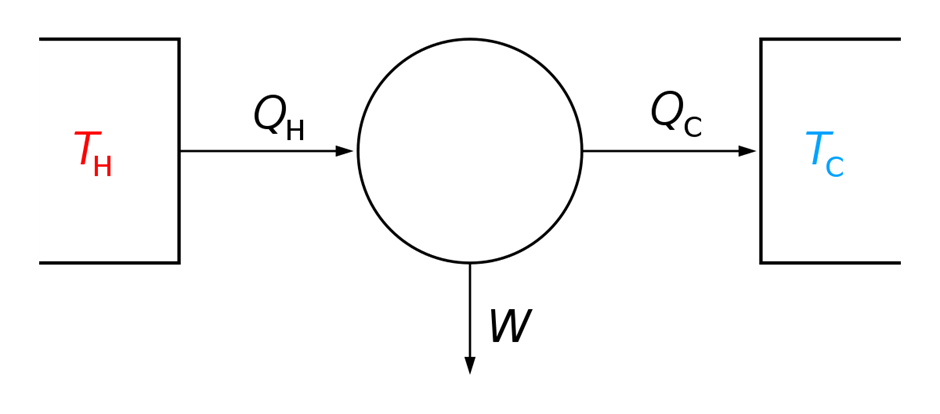
Read the passage given below and answer the following questions from (i) to (v) Carnot principles are only for the cyclical devices like heat engines, which state that the efficiency of an irreversible heat engine is always less than the efficiency of a reversible one operating between the same two reservoirs. The efficiencies of all reversible heat engines operating between the same two reservoirs are the same.
  1. In a Carnot cycle, the working medium rejects heat at a ________ temperature.
    1. Higher
    2. Lower
    3. constant
    4. none of these
  2. Which of the following is NOT a state variable?
    1. work
    2. internal energy.
    3. entropy
    4. all of the above
  3. The efficiency of reversible heat engine is:
    1. $1 +(T_2/T_1)$
    2. $(T_1/T_2)+1$
    3. $(T_1 /T_2)- 1$
    4. $1 - (T_2 / T_1)$
  4. Other factors remaining constant, if the temperature of the source is increased, the efficiency of the Carnot engine will:
    1. decrease
    2. increase
    3. constant
    4. increase or decrease depending upon temperature ratio
  5. Over the complete Carnot cycle, entropy:
    1. increase
    2. decrease
    3. constant
    4. first increase and then decrease

Answer

  1. (b) lower
  2. (a) Work
  3. (d) $1- (T_2/ T_1)$
  4. (b) increase
  5. (c) constant

Need a full question paper?

Generate a complete, print-ready paper with questions like this in minutes — across 16+ boards, with answer keys.

Start Generating Free

Similar questions

The plate current in a triode can be written as $\text{i}_\text{p}=\text{k}\Big(\text{V}_\text{g}+\frac{\text{V}_\text{p}}{\mu}\Big)^{\frac{3}{2}}$ Show that the mutual conductance is proportional to the cube root of the plate current.
Find the change in the volume of 1.0 litre kerosene when it is subjected to an extra pressure of $2.0 \times 10^5 \mathrm{~N} / \mathrm{m}^2$ from the following data. Density of kerosene $=800 \mathrm{~kg} / \mathrm{m}^3$ and speed of sound in kerosene $=1330 \mathrm{~m} / \mathrm{s}$.
An elevator is descending with uniform acceleration. To measure the acceleration, a person in the elevator drops a coin at the moment the elevator starts. The coin is 6ft above the floor of the elevator at the time it is dropped. The person observes that the coin strikes the floor in 1 second. Calculate from these data the acceleration of the elevator.
Read the passage given below and answer the following questions from (i) to (v). Pressure of an Ideal Gas: according to kinetic theory of gases pressure is given by $\text{P}=\frac{1}{3}\text{ nmv}^2$
Where, n is number of molecules per unit volume, m is mass and $v^2$ is mean squared speed. Though we choose the container to be a cube, the shape of the vessel really is immaterial. The average kinetic energy of a molecule is proportional to the absolute temperature of the gas; it is independent of pressure, volume or the nature of the ideal gas. This is a fundamental result relating temperature, a macroscopic measurable parameter of a gas (a thermodynamic variable as it is called) to a molecular quantity, namely the average kinetic energy of a molecule. The two domains are connected by the Boltzmann constant and given by $E = k_bT$. Where kb is Boltzmann constant having value of $1.38 \times 10^{-23}$ joule per Kelvin. We have seen that in thermal equilibrium at absolute temperature T, for each translational mode of motion, the average energy is $\frac{1}{2}\text{K}_\text{b}\text{t}$. The most elegant principle of classical statistical mechanics (first proved by Maxwell) states that this is so for each mode of energy: translational, rotational and vibrational. That is, in equilibrium, the total energy is equally distributed in all possible energy modes, with each mode having an average energy equal to $\frac{1}{2}\text{K}_\text{b}\text{t}$. This is known as the law of equipartition of energy. Accordingly, each translational and rotational degree of freedom of a molecule contributes $\frac{1}{2}\text{K}_\text{b}\text{t}$ to the energy, while each vibrational frequency contributes $2\times\frac{1}{2}\text{Kb T}=\text{K}_\text{b}\text{T}$ since a vibrational mode has both kinetic and potential energy modes.
  1. Boltzmann constant has value of:
  1. 1.38 × 10 - 23 joule per Kelvin.
  2. 1.38 × 10 - 28 joule per Kelvin.
  3. 1.38 × 10 - 30 joule per Kelvin.
  4. None of these.
  1. SI unit of Boltzmann constant is given by:
  1. Joules per meter
  2. Joules per Kelvin
  3. Joules per Newton
  4. None of these
  1. According to kinetic theory give formula for pressure of idea gas.
  2. According to kinetic theory what is average kinetic energy of molecules of ideal gas?
  3. What is law of equipartition of energy?
A short magnet oscillates in an oscillation magnetometern with a time period of 0.10s where the earth's horizontal magnetic field is $24\mu\text{T}.$ A downward current of 18 A is established in a vertical wire placed 20cm east of the magnet. Find the new time period.
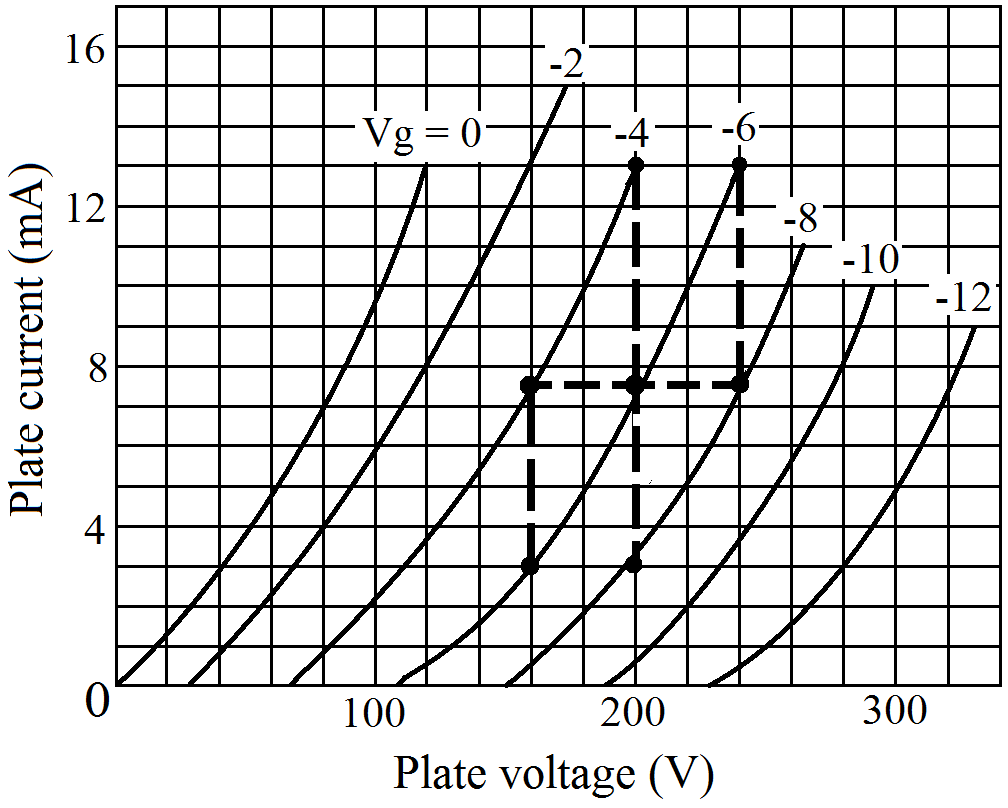
Find the values of $\text{r}_\text{p},\ \mu$ and $\text{g}_\text{m}$ of a triode operating at plate voltage 200V and grid voltage -6. The plate characteristics are shown in the figure.
The combination of two bar magnets makes 10 oscillations per second in an oscillation magnetometer when like poles are tied together and 2 oscillations per second when unlike poles are tied together. Find the ratio of the magnetic moments of the magnets. Neglect any induced magnetism.
Read the passage given below and answer the following questions from 1 to 5. If a stone is thrown by hand, we see it falls back to the earth. Of course using machines we can shoot an object with much greater speeds and with greater and greater initial speed, the object scales higher and higher heights. A natural query that arises in our mind is the following: can we throw an object with such high initial speeds that it does not fall back to the earth ? Thus minimum speed required to throw object to infinity away from earth’s gravitational field is called escape velocity. $\text{V}_{\text{e}}=\sqrt{(2\text{gr})}$ Where g is acceleration due to gravity and r is radius of earth and after solving ve $11.2$ km/s. This is called the escape speed, sometimes loosely called the escape velocity. This applies equally well to an object thrown from the surface of the moon with g replaced by the acceleration due to Moon’s gravity on its surface and r replaced by the radius of the moon. Both are smaller than their values on earth and the escape speed for the moon turns out to be $2.3$ km/s, about five times smaller. This is the reason that moon has no atmosphere. Gas molecules if formed on the surface of the moon having velocities larger than this will escape the gravitational pull of the moon. Earth satellites are objects which revolve around the earth. Their motion is very similar to the motion of planets around the Sun and hence Kepler’s laws of planetary motion are equally applicable to them. In particular, their orbits around the earth are circular or elliptic. Moon is the only natural satellite of the earth with a near circular orbit with a time period of approximately $27.3$ days which is also roughly equal to the rotational period of the moon about its own axis.
  1. Time period of moon is:
  1. 27.3 days
  2. 20 days
  3. 85 days
  4. None of these
  1. Escape velocity from earth is given by:
  1. 20 km/s
  2. 11.2 km/s
  3. 2 km/s
  4. None of these
  1. Define escape velocity. Give its formula.
  1. Why moon don’t Have any atmosphere?
  1. What is satellite? Which law governs them?
Read the passage given below and answer the following questions from (i) to (v). This principle is a consequence of Newton’s second and third laws of motion. In an isolated system (i.e. a system having no external force), mutual forces (called internal forces) between pairs of particles in the system causes momentum change in individual particles. Let a bomb be at rest, then its momentum will be zero. If the bomb explodes into two equal parts, then the parts fly off in exactly opposite directions with same speed, so that the total momentum is still zero. Here, no external force is applied on the system of particles (bomb).
  1. A bullet of mass 10g is fired from a gun of mass 1kg with recoil velocity of gun 5m/ s. The muzzle velocity will be:
  1. 30km/ min
  2. 60km/ min
  3. 30m/ s
  4. 500m/ s
  1. A shell of mass 10 kg is moving with a velocity of 10 ms" 1 when it blasts and forms two parts of mass 9 kg and 1 kg respectively. If the first mass is stationary, the velocity of the second is:
  1. $1ms^{-1}$
  2. $10ms^{-1}$
  3. $100ms^{-1}$
  4. $1000ms^{-1}$
  1. A bullet of mass 0.1kg is fired with a speed of 100ms’ 1 . The mass of gun being 50kg, then the velocity of recoil becomes:
  1. $0.05ms^{-1}$
  2. $0.5ms^{-1}$
  3. $0.lms^{-1}$
  4. $0.2ms^{-1}$
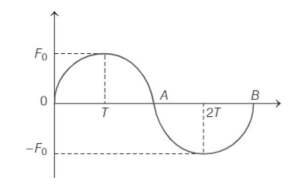
  1. A unidirectional force F varying with time Tas shown in the figure acts on a body initially at rest for a short duration:
2.T. Then, the velocity acquired by the body is
  1. $\frac{\pi\text{F}_\text{o}\text{T}}{4\text{m}}$
  2. $\frac{\pi\text{F}_\text{o}\text{T}}{2\text{m}}$
  3. $\frac{\text{F}_\text{o}\text{T}}{4\text{m}}$
  4. $\text{zero}$
  1. Two masses ofM and 4Af are moving with equal kinetic energy. The ratio of their linear momenta is
  1. $1 : 8$
  2. $1 : 4$
  3. $1 : 2$
  4. $4 : 1$
Read the passage given below and answer the following questions from (i) to (v). Root mean square velocity (RMS value)is the square root of the mean of squares of the velocity of individual gas molecules and the Average velocity is the arithmetic mean of the velocities of different molecules of a gas at a given temperature.
  1. Moon has no atmosphere because:-
    1. It is far away from the surface of the earth
    2. Its surface temperature is 10°C
    3. The r.m.s. velocity of all the gas molecules is more than the escape velocity of the moon’s surface
    4. The escape velocity of the moon’s surface is more than the r.m.s velocity of all molecules
  2. For an ideal gas, CPCV is
    1. >1
    2. <1
    3. ≤1
    4. none of these
  3. The root mean square velocity of hydrogen is 5 times than that of nitrogen. If T is the temperature of the gas then:
    1. $T(H_2) = T(N_2)$
    2. $T(H_2) < T(N_2)$
    3. $T(H_2) > T(N_2)$
    4. none of these
  4. Suppose the temperature of the gas is tripled and $N_2$ molecules dissociate into an atom. Then what will be the rms speed of atom:
    1. v06
    2. v0
    3. v03
    4. none of these
  5. The velocities of the molecules are v, 2v, 3v, 4v & 5v. The rms speed will be:
    1. $11 v$
    2. $v(11)^{12}$
    3. $v$
    4. $v(12)^{11}$