Question
A silver sphere of radius $1\ cm$ and work function $4.7 \ eV$ is suspended from an insulating thread in free-space. It is under continuous illumination of $200 \ nm$ wavelength light. As photoelectrons are emitted, the sphere gets charged and acquires a potential. The maximum number of photoelectrons emitted from the sphere is $A \times 10^2$ (where $1 < A < 10$ ). The value of  $'Z '$ is
Answer

Let $x$ be the maximum number of photo electrons emitted.

The potential $V$ of the sphere can be calculated as : $U =\frac{ Kq }{ R }$

$V =\frac{9 \times 10^9 \times x \times 1.6 \times 10^{-1} 19}{10^{-2}}= x \times 14.4 \times 10^{-8} $

$ U = eV = x \times 14.4 \times 10^{-8} \times 1.6 \times 10^{-19}= x \times 23.04 \times 10^{-27} J$

From conservation of energy :

$U =\frac{ hC }{\lambda}-\phi $

$x \times 23.04 \times 10^{-27}=\frac{2 \times 10^{-25}}{200 \times 10^{-9}}-4.7 \times 1.6 \times 10^{-19} $

$x =\frac{10^{-18}-7.52 \times 10^{-19}}{23.04 \times 10^{-27}}=1.076 \times 10^7$

$\therefore Z =7$

Need a full question paper?

Generate a complete, print-ready paper with questions like this in minutes — across 16+ boards, with answer keys.

Start Generating Free

Similar questions

In the visible region the dispersive powers and the mean angular deviations for crown and flint glass prisms are $\omega , \omega '$ and $d, d' $ respectively. The condition for getting deviation without dispersion when the two prisms are combined is
A gun fires a bullet of mass $50 \,gm$ with a velocity of $30\,m\,{\sec ^{ - 1}}$. Because of this the gun is pushed back with a velocity of $1\,m\,{\sec ^{ - 1}}$. The mass of the gun is .......... $kg$
The radiation corresponding to $3 \rightarrow 2$ transition of hydrogen atom falls on a metal surface to produce photoelectrons. These electrons are made to enter a magnetic field of $3 \times 10^{-4} T$. If the radius of the largest circular path followed by these electrons is 10.0 mm , the work function of the metal is close to
An optically active compound $'X'$ having molecular formula $C_4H_8O_3$ it evolves $CO_2$ with $NaHCO_3$.$'x'$ on treatment with $LiAlH_4$ gives achiral compound then $'x'$ is
$Assertion$ : The earth without atmosphere would be inhospitably cold.
$Reason$ : All heat would escape in the absence of atmosphere.
Electric lines of force about negative point charge are
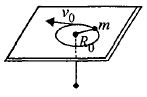
A mass $m$ moves in a circle on a smooth  horizontal plane with velocity $v_0$ at a radius $R_0$ . The mass is attached to a string which passes through a smooth hole in the plane as  shown.The tension in the string is increased gradually and finally $m$ moves in a circle of radius  $\frac{{{R_0}}}{2}$. The final value of the kinetic energy is
$10\; amu =$ ……..$kg$
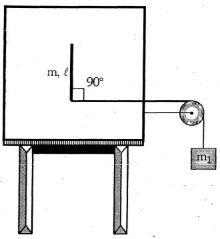
There is a rod of lenght $l$, mass $m$ lying on a fixed horizontal smooth table. A cord is led through a pulley, and its horizontal part is attached to one end of the rod, while its vertical part is attached to a block of mass $m_1$.  Assume pulley and the cord is ideal. The maximum possible acceleration of the rod's centre of mass $C$ (for all possible values of masses $m$ and $m_1$) at the moment of releasing the block $m_1$ is $\frac{g}{n}$.  Find the value of $n$


Three forces $\vec{F}_1=(2 \hat{i}+4 \hat{j}) \,N ; \vec{F}_2=(2 \hat{j}-\hat{k}) \,N$ and $\vec{F}_3=(\hat{k}-4 \hat{i}-2 \hat{j}) \,N$ are applied on an object of mass $1 kg$ at rest at origin. The position of the object at $t=2 s$ will be