MCQ
$10\; amu =$ ……..$kg$
  • A
    $1.66 × 10^{-27} kg$
  • B
    $1.66 × 10^{-24} kg$
  • $1.66 × 10^{-26} kg$
  • D
    $1.66 × 10^{-28} kg$

Answer

Correct option: C.
$1.66 × 10^{-26} kg$
c
$1 amu = 1.66 ×10^{-27}kg  $

$ 10amu = 10 ×1.66 × 10^{-27} = 1.66 × 10^{-26} kg$

Need a full question paper?

Generate a complete, print-ready paper with questions like this in minutes — across 16+ boards, with answer keys.
Start Generating Free

Similar questions

The moment of inertia of a meter scale of mass $0.6\, kg$ about an axis perpendicular to the scale and  located at the $20\, cm$ position on the scale in $kg \,m^2$ is  (Breadth of the scale is negligible
The force-deformation equation for a nonlinear spring fixed at one end is $F =4x^{1/ 2}$  , where $F$ is the force (expressed in newtons) applied at the other end and $x$ is the deformation expressed in meters
Imagine an atom made up of a proton and a hypothetical particle of double the mass of the electron but having the same charge as the electron. Apply the Boh’r atocited level. The longest wavelength photon that will be emitted has wavelength $\lambda$ (given in terms of the Rydberg constant $R$ for the hydrogen atom) equal to
A small mass $'m'$ rests at the edge of a horizontal disc of radius $'R'$ . The coefficient of static friction between mass and the disc is $\mu $ . The disc is rotated about its axis at an angular velocity such that the mass slides off the disc and lands on the floor $'h'$ meters below. What was its horizontal distance of travel from the point it left the disc?
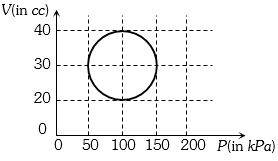
A system is taken through a cyclic process represented by a circle as shown. The heat absorbed by the system is
At the surface of a certain planet, acceleration due to gravity is one-quarter of that on earth. If a brass ball is transported to this planet, then which one of the following statements is not correct
Light takes $8$ min $ 20\, sec$ to reach from sun on the earth. If the whole atmosphere is filled with water, the light will take the time ($_a{\mu _w} = 4/3$)
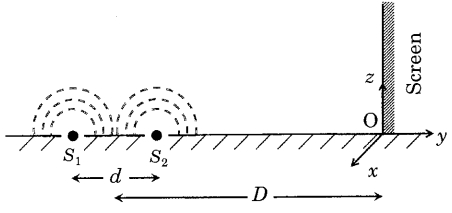
While conducting the Young's double slit experiment, a student replaced the two slits with a large opaque plate in the $x-y$ plane containing two small holes that act as two coherent point sources $\left(S_1, S_2\right)$ emitting light of wavelength $600 \mathrm{~nm}$. The student mistakenly placed the screen parallel to the $x-z$ plane (for $z>0$ ) at a distance $D=3 \mathrm{~m}$ from the mid-point of $S_1 S_2$, as shown schematically in the figure. The distance between the sources $d=0.6003 \mathrm{~mm}$. The origin $\mathrm{O}$ is at the intersection of the screen and the line joining $S_1 S_2$. Which of the following is(are) true of the intensity pattern on the screen?

($A$) Straight bright and dark bands parallel to the $x$-axis

($B$) The region very close to the point $O$ will be dark

($C$) Hyperbolic bright and dark bands with foci symmetrically placed about $\mathrm{O}$ in the $x$-direction

($D$) Semi circular bright and dark bands centered at point $\mathrm{O}$
The maximum horizontal range of a projectile is $400\;m$.The maximum height atteined by it?
Air (density $\rho$ ) is being blown on a soap film (surface tension $T$ ) by a pipe of radius $R$ with its opening right next to the film. The film is deformed and a bubble detaches from the film when the shape of the deformed surface is a hemisphere. Given that the dynamic pressure on the film due to the air blown at speed $v$ is $\frac{1}{2} \rho v^{2}$, the speed at which the bubble formed is