MCQ
A simple harmonic oscillator has an amplitude $A$ and time period $6 \pi$ second. Assuming the oscillation starts from its mean position, the time required by it to travel from $x=A$ to $x=\frac{\sqrt{3}}{2} A$ will be $\frac{\pi}{x}$ s, where $x=$__________.
  • $2$
  • B
    $12$
  • C
    $4$
  • D
    $9$

Answer

Correct option: A.
$2$
a
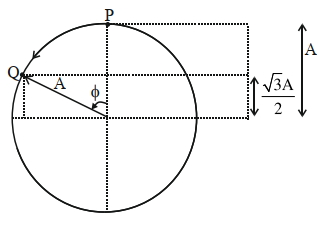
From phasor diagram particle has to move from $\mathrm{P}$ to $Q$ in a circle of radius equal to amplitude of $SHM.$

$ \cos \phi=\frac{\frac{\sqrt{3} \mathrm{~A}}{2}}{\mathrm{~A}}=\frac{\sqrt{3}}{2} $

$ \phi=\frac{\pi}{6}$

Now, $\frac{\pi}{6}=\omega t$

$\frac{\pi}{6}=\frac{2 \pi}{T} t$

$\frac{\pi}{6}=\frac{2 \pi}{6 \pi} t$

$\mathrm{t}=\frac{\pi}{2}$

So, $\mathrm{x}=2$

Need a full question paper?

Generate a complete, print-ready paper with questions like this in minutes — across 16+ boards, with answer keys.

Start Generating Free

Similar questions

A satellite is orbiting the earth. If its distance from the earth is increased, its:
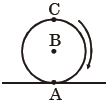
A sphere is rolling without slipping on a fixed horizontal plane surface. In the figure $A$ is the point of contact, $B$ is the centre of sphere and $C$ is its topmost point, then

$(i){\vec V_C} - {\vec V_A} = 2\left( {{{\vec V}_B} - {{\vec V}_C}} \right)$

$(ii){\vec V_C} - {\vec V_B} = {\vec V_B} - {\vec V_A}$

$(iii)\left| {{{\vec V}_C} - {{\vec V}_A}} \right| = 2\left| {{{\vec V}_B} - {{\vec V}_C}} \right|$

$(iv)\left| {{{\vec V}_C} - {{\vec V}_A}} \right| = 4\left| {{{\vec V}_B}} \right|$

How many times more intense is $90\,\, dB$ sound than $40\,\, dB$ sound?
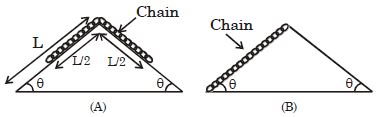
A uniform chain of mass $m$ and length $L$ is originally placed mid-way on the top of a fixed smooth double-sided wedge (Figure- $A$). The length of each side of the wedge is $L$ . It is then given a slight push. The kinetic energy of the chain when the whole chain has just slid to the left side of the wedge (Figure- $B$), is :
A string tied on a roof can bear a maximum tension of $50 \,kg$ wt. The minimum acceleration that can be acquired by a man of $98 \,kg$ to descend will be ...... $m / s ^2$ [Take $g=9.8 \,m / s ^2$ ]
The escape velocity or earth is V. If the mass of a certain planet is 3 times and radius 3 times than that of the earth, then the escape velocity from the planet will be:
A Carnot's engine used first an ideal monoatomic gas then an ideal diatomic gas. If the source and sink temperature are ${411^o}C$ and ${69^o}C$ respectively and the engine extracts $1000\, J $ of heat in each cycle, then area enclosed by the $PV$ diagram is ........ $J$
Three identical spheres each of mass $M$ are placed at the corners of a right angled triangle with mutually perpendicular sides equal to $3\,m$ each. Taking point of intersection of mutually perpendicular sides as origin, the magnitude of position vector of centre of mass of the system will be $\sqrt{x} m$. The value of $x$ is
Two waves of frequencies $20 Hz$ and $30 Hz.$ Travels out from a common point. The phase difference between them after $0.6 sec$ is
Two particles undergo $SHM$ along parallel lines with the same time period $(T)$ and equal amplitudes. At a particular instant, one particle is at its extreme position while the other is at its mean position. They move in the same direction. They will cross each other after a further time