Question
A simple microscope is rated 5 for a normal relaxed eye. What will be its magnifying power for a relaxed farsighted eye whose near point is 40cm?

Answer

The simple microscope has magnification of 5 for normal relaxed eye (D = 25cm).

Because, the eye is relaxed the image is formed at infinity (normal adjustment)

So, $\text{m}=5=\frac{\text{D}}{\text{f}}=\frac{25}{\text{f}}\Rightarrow\text{f}=5\text{cm}$

For the relaxed farsighted eye, $\text{D} = 40\text{cm}$

So, $\text{m}=\frac{\text{D}}{\text{f}}=\frac{40}{5}=8$

So, its magnifying power is 8X.

Need a full question paper?

Generate a complete, print-ready paper with questions like this in minutes — across 16+ boards, with answer keys.
Start Generating Free

Similar questions

Identify the electromagnetic waves whose wavelengths lie in the range:
  1. 10–11 m < $\lambda$ < 10–14 m
  2. 10–4 m < $\lambda$ < 10–6 m
Write one use for each.
What is the work function of metal? It depends on which factors?
A wooden block of mass 0.5kg and density 800kg/m3 is fastened to the free end of a vertical spring of spring constant 50N/m fixed at the bottom. If the entire system is completely immersed in water, find.
  1. The elongation (or compression) of the spring in equilibrium and.
  2. The time-period of vertical oscillations of the block when it is slightly depressed and released.
When light travels from an optically denser medium to a rarer medium, why does the critical angle of incidence depend on the color of the light?
How the speed of revolving electron in stable orbit is related to principal quantum number?
  1. Find the first excitation potential of He+ ion.
  2. Find the ionization potential of Li++ ion.
Monochromatic light entering from one medium to another, its wavelength changes but the frequency does not change, explain.
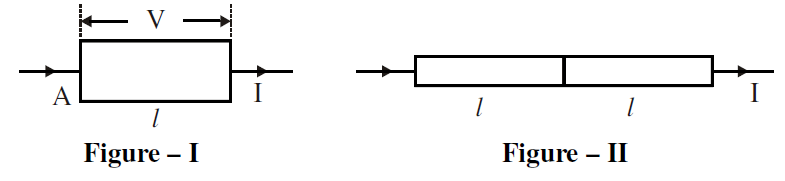
A metal rod of square cross-sectional area A having length l has current I flowing through it when a potential difference of V volt is applied across its ends (figure I). Now the rod is cut parallel to its length into two identical pieces and joined as shown in figure II. What potential difference must be maintained across the length 2l so that the current in the rod is still I?

Write down the difference between vacuum tube (valve) and semiconductors.
A tuning fork produces 4 beats per second with another tuning fork of frequency 256Hz. The first one is now loaded with a little wax and the beat frequency is found to increase to 6 per second. What was the original frequency of the tuning fork?