Question
A simple microscope is rated 5 for a normal relaxed eye. What will be its magnifying power for a relaxed farsighted eye whose near point is 40cm?

Answer

The simple microscope has magnification of 5 for normal relaxed eye (D = 25cm).Because, the eye is relaxed the image is formed at infinity (normal adjustment)
So, $\text{m}=5=\frac{\text{D}}{\text{f}}=\frac{25}{\text{f}}\Rightarrow\text{f}=5\text{cm}$
For the relaxed farsighted eye, $\text{D} = 40\text{cm}$
So, $\text{m}=\frac{\text{D}}{\text{f}}=\frac{40}{5}=8$
So, its magnifying power is 8X.

Need a full question paper?

Generate a complete, print-ready paper with questions like this in minutes — across 16+ boards, with answer keys.
Start Generating Free

Similar questions

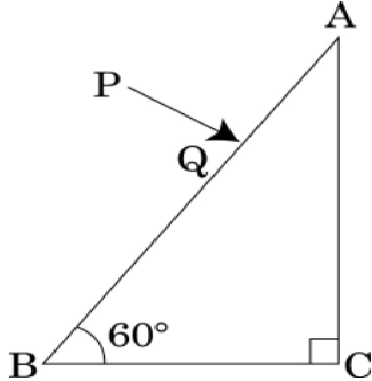
A ray PQ incident normally on the refracting face BA is refracting in the prism BAC made of material of refractive index1.5. Complete the path of ray through the prism. From which face will the ray emerge? Justify your answer.
State Lenz’s Law.
A metallic rod held horizontally along east-west direction, is allowed to fall under gravity. Will there be an emf induced at its ends? Justify your answer.
Derive the formula for electrostatic potential due to a point charge.
The force on a north pole,$\overrightarrow{\text{F}}=\text{m}\overrightarrow{\text{B}},$ is parallel to the field $\overrightarrow{\text{B}}.$ Does it contradict our earlier knowledge that a magnetic field can exert forces only perpendicular to itself?
Electrons are emitted from an electron gun at almost zero velocity and are accelerated by an electric field E through a distance of 1.0m. The electrons are now scattered by an atomic hydrogen sample in ground state. What should be the minimum value of E so that red light of wavelength 656.3nm may be emitted by the hydrogen?
Unit of magnetic flux is weber. State its equivalent electric unit
You are standing with your bag in your hands, on the ice in the middle of a pond. The ice is so slippery that it can offer no friction. How can you come out of the ice?
From the formula of potential energy of a system of two charges, obtain the equation of $P.E$. of electric dipole in external electric field.
Find the maximum kinetic energy of the photoelectrons ejected when light of wavelength 350nm is incident on a cesium surface. Work function of cesium = 1.9eV
Distinguish between 'intrinsic' and 'extrinsic' semiconductors.