Question
Derive the formula for electrostatic potential due to a point charge.

Answer

Image

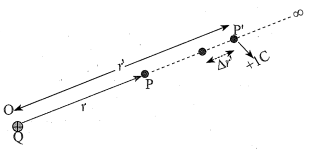
As shown in fig., charge $Q(Q>0)$ is placed on the origin of the cartesian co-ordinates system. We want to find electric potential at some point P , having its position vector $\vec{r}$ from origin O. For this we should calculate work done by external force in bringing unit positive charge (test charge) from infinity to point $P$.
Suppose, there is a point $P ^{\prime}$ at distance $r^{\prime}$ in between the path from infinity to P .
Force on unit positive charge kept at point $P ^{\prime}$ is
$\overrightarrow{ F }^{\prime}=\frac{1}{4 \pi \varepsilon_0} \cdot \frac{ Q }{r^{\prime^2}} \cdot \hat{r}^{\prime}$

Where $\hat{r}^{\prime}$ is the unit vector in the direction of $\overrightarrow{ OP ^{\prime}}$.

The work done against the (field) force in giving $\overrightarrow{\Delta r^{\prime}}$ displacement to the unit positive charge,
$\Delta W =-\frac{1}{4 \pi \varepsilon_0} \cdot \frac{ Q }{r^{\prime 2}} \cdot \Delta r^{\prime}$

Need a full question paper?

Generate a complete, print-ready paper with questions like this in minutes — across 16+ boards, with answer keys.
Start Generating Free

Similar questions

Explain the term ‘drift velocity’ of electrons in a conductor. Hence obtain the expression for the current through a conductor in terms of ‘drift velocity’.
Definitions needed to understand reflection from a Spherical mirror :

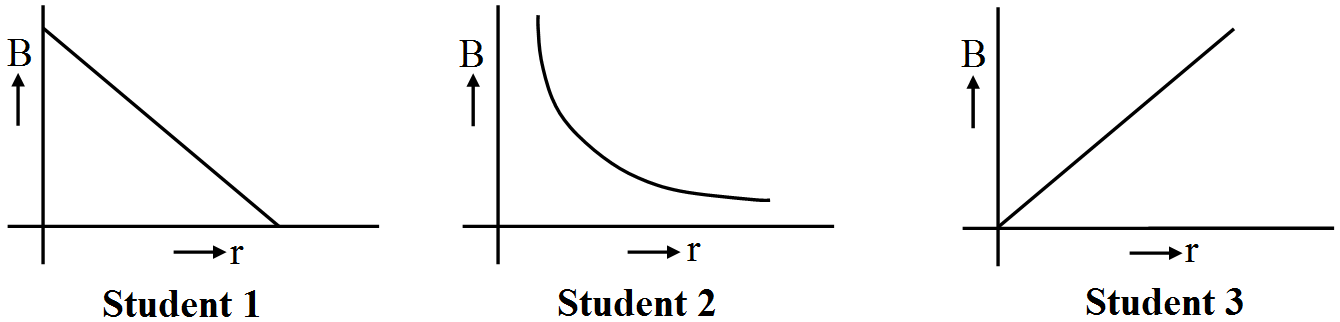
Three students represent the variation of magnetic field B with distance r for a straight infinity long current carrying conductor as:

Which of the three students has drawn the graph correctly and why?
The gravitational field in a region is given by $\text{E}=(2\hat{\text{i}}+3\hat{\text{i}})\text{N/kg}.$ Show that no work is done by the gravitational field when a particle is moved on the line 3y + 2x = 5.
Hint: If a line y = mx + c makes angle $\theta$ with the X-axis, m $=\tan\theta$
The electric current in a charging R-C circuit is given by $\text{i}=\text{i}_0\text{e}^{-\frac{\text{t}}{\text{RC}}}$ where $\text{i}_0,$ R and C are constant parameters of the circuit and t is time. Find the rate of change of current at
  1. t = 0.
  2. t = RC.
  3. t = 10RC.
What is the physical significance of negative energy of electron in Bohr's atom?
A steel rod is clamped at its two ends and rests on a fixed horizontal base. The rod is unstrained at $20^\circ C$. Find the longitudinal strain developed in the rod if the temperature rises to $50^\circ C$. Coefficient of linear expansion of steel $= 1.2 \times 10^{-5} $$^\circ C^{-1}.$
Define trans conductance of a transistor.
Calculate the shortest wavelength in the Balmer series of hydrogen atom. In which region (infra-red, visible, ultraviolet) of hydrogen spectrum does this wavelength lie?
Three capacitors each of capacitance 9 pF are connected in series.
  1. What is the total capacitance of the combination?
  2. What is the potential difference across each capacitor if the combination is connected to a 120 V supply?