Question
A simple microscope using a single lens often shows coloured image of a white source. Why?

Answer

A simple microscope consists of a single convex lens. Sometimes due to chromatic and spherical aberrations, the image of a white source seems coloured at the corners of the lens and somewhere in between.

Need a full question paper?

Generate a complete, print-ready paper with questions like this in minutes — across 16+ boards, with answer keys.
Start Generating Free

Similar questions

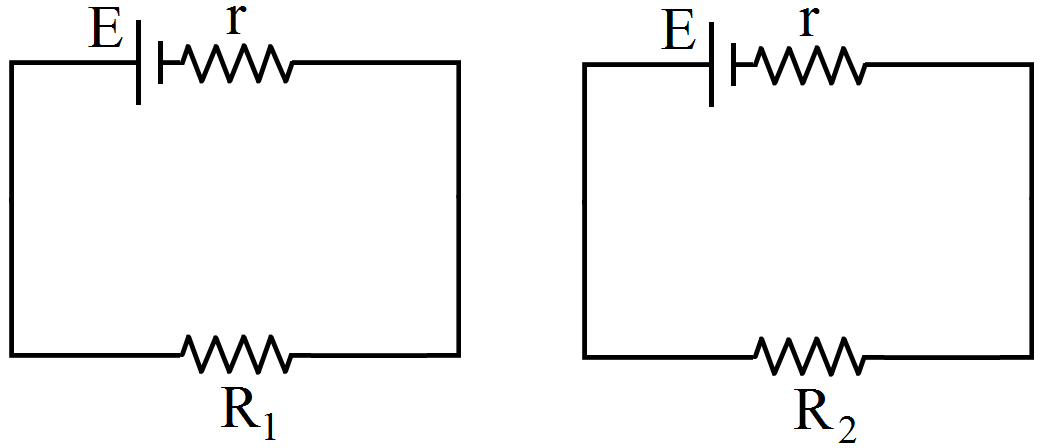
Two unequal resistances R1 and R2 are connected across two identical batteries of emf $\varepsilon$ and internal resistance r. Can the thermal energies developed in R1 and Rbe equal in a given time. If yes, what will be the condition?

What is Lorentz force ?
Define the phenomenon of total internal reflection.
Verify that the units weber and volt-second are the same.
When three identical capacitors are connected in series, their equivalent (total) capacitance is $1 \mu F$. If they are connected in parallel, what will be their total capacitance? If the capacitors are connected to the same source in both the conditions (combinations), then find the ratio of the stored energy in these two types of combinations.
Two charges are placed in air at some distance:(a) If a glass slab whose dielectric constant is 8 is placed between them, then what will be the change in the magnitude of the force acting between them?(b) What will happen if the piece of brass is kept?
The susceptibility of magnesium at 300K is 1.2 × 10-5. At what temperature will the susceptibility increase to 1.8 × 10-5?
Explain Rutherford's argument for scattered $\alpha$-particles.
A body builder exerts a force of 150N against a bullworker and compresses it by 20cm. Calculate the spring constant of the spring in the bullworker.
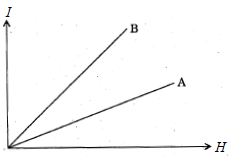
The following figure shows the variation of intensity of magnetisation versus the applied magnetic field intensity, H, for two magnetic materials A and B:

  1. Identify the materials A and B.
  2. Why does the material B, have a larger susceptibility than A, for a given field at constant temperature?