Question
Explain Rutherford's argument for scattered $\alpha$-particles.

Answer

In $\alpha$-particle scattering experiment most $\alpha$-particles pass through without being detected.
Only about $0.14 \% \alpha$-particles scatter by more than $1^{\circ}$ and about 1 in 8000 deflect by more than $90^{\circ}$.
For this Rutherford argued that for the $\alpha$-particle to be deflected backwards it must experience a large repulsive force.
This is possible only when almost entire mass of the atom is concentrated in its center and this center is positively charged.
Then incoming $\alpha$-particle could get very close to the positive charge without penetrating it and such a close encounter would result in a large deflection.
This agreement supported the hypothesis of the nuclear atom. This is why Rutherford is credited with the discovery of the nucleus.

Need a full question paper?

Generate a complete, print-ready paper with questions like this in minutes — across 16+ boards, with answer keys.
Start Generating Free

Similar questions

What are eddy currents? Write any two applications of eddy currents.
Two transparent slabs having equal thickness but different refractive indices $\mu_1$ and $\mu_2$ are pasted side by side to form a composite slab. This slab is placed just after the double slit in a Young's experiment so that the light from one slit goes through one material and the light from the other slit goes through the other material. What should be the minimum thickness of the slab so that there is a minimum at the point P0 which is equidistant from the slits?
de Broglie wavelength associated with an electron accelerated through a potential difference V is $\lambda$ What will be the de Broglie wavelength when the accelerating potential is increased to 4V?
If a compressed spring is dissolved in acid, what happened to the elastic potential energy of the spring?
  1. Can two equipotential surfaces intersect each other? Give reasons.
  2. Two charges – q and +q are located at points A (0, 0, –a) and B (0, 0, +a) respectively. How much work is done in moving a test charge from point P (7, 0, 0) to Q (-3, 0, 0)?
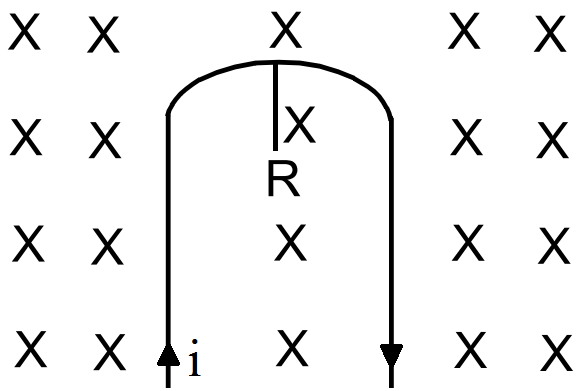
A rigid wire consists of a semi-circular portion of radius R and two straight sections The wire is partially immersed in a perpendicular magnetic field B, as shown in the figure. Find the magnetic force on the wire if it carries a current i.

The contact angle between water and glass is 0º. When water is poured in a glass to the maximum of its capacity, the water surface is convex upward. The angle of contact in such a situation is more than 90º. Explain.
A simple microscope is rated 5 for a normal relaxed eye. What will be its magnifying power for a relaxed farsighted eye whose near point is 40cm?
Explain ground state and ionisation energy of hydrogen atom.
Estimate the average drift speed of conduction electrons in a copper wire of cross-sectional area 1.0 x10⁻⁷ m2 carrying a current of 1.5 A. Assume the density of conduction electrons to be 9 x1028 m–3.