A simple pendulum consisting of a ball of mass $m$ tied to a thread of length $l$ is made to swing on a circular arc of angle $\theta $ in a vertical plane. At the end of this arc, another ball of mass $m$ is placed at rest. The momentum transferred to this ball at rest by the swinging ball is
Easy


Download our appand get started for free
Experience the future of education. Simply download our apps or reach out to us for more information. Let's shape the future of learning together!No signup needed.*
Similar Questions
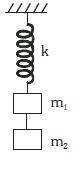
- 1Two masses $m_1$ and $m_2$ are supended together by a massless spring of constant $k$. When the masses are in equilibrium, $m_1$ is removed without disturbing the system; the amplitude of vibration isView Solution
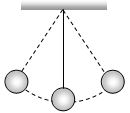
- 2What is the velocity of the bob of a simple pendulum at its mean position, if it is able to rise to vertical height of $10cm$ ......... $m/s$ (Take $g = 9.8\,m/{s^2})$View Solution
- 3A body of mass $5\, gm$ is executing $S.H.M.$ about a point with amplitude $10 \,cm$. Its maximum velocity is $100\, cm/sec$. Its velocity will be $50\, cm/sec$ at a distanceView Solution
- 4A block of mass $1 \,kg$ attached to a spring is made to oscillate with an initial amplitude of $12\, cm$. After $2\, minutes$ the amplitude decreases to $6\, cm$. Determine the value of the damping constant for this motion. (take In $2=0.693$ )View Solution
- 5The phase difference between two $SHM\,\,$ ${y_1}\, = \,10\,\sin \,\left( {10\pi t\, + \,\frac{\pi }{3}} \right)$ and ${y_2}\, = \,12\,\sin \,\left( {8\pi t\, + \,\frac{\pi }{4}} \right)$ at $t = 0.5\,s$ itView Solution
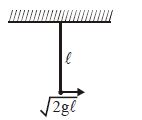
- 6A simple pendulum having length $\ell $ is having speed $\sqrt {2g\ell }$ at bottom most point of its trajectory. Its motion will beView Solution
- 7A simple pendulum with a metallic bob has a time period $T$. The bob is now immersed in a non-viscous liquid and oscillated. If the density of the liquid is $1 / 4$ that of metal, the time period of the same pendulum will be ...........View Solution
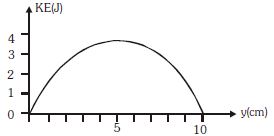
- 8A mass on a vertical spring begins its motion at rest at $y = 0\ cm$. It reaches a maximum height of $y = 10\ cm$. The two forces acting on the mass are gravity and the spring force. The graph of its kinetic energy ($KE$) versus position is given below. Net force on the mass varies with $y$ asView Solution
- 9View SolutionThe graph between velocity and position for a damped oscillation will be
- 10A $S.H.M.$ is represented by $x = 5\sqrt 2 (\sin 2\pi t + \cos 2\pi t).$ The amplitude of the $S.H.M.$ is .... $cm$View Solution