A block of mass $1 \,kg$ attached to a spring is made to oscillate with an initial amplitude of $12\, cm$. After $2\, minutes$ the amplitude decreases to $6\, cm$. Determine the value of the damping constant for this motion. (take In $2=0.693$ )
JEE MAIN 2021, Diffcult
Download our app for free and get started
$A = A _{0} e ^{-\gamma\, t}$
$\ln 2=\frac{ b }{2 m } \times 120$
$\frac{0.693 \times 2 \times 1}{120}= b$
$1.16 \times 10^{-2} \,kg / sec$

Download our appand get started for free
Experience the future of education. Simply download our apps or reach out to us for more information. Let's shape the future of learning together!No signup needed.*
Similar Questions
- 1A particle moves such that its acceleration $a$ is given by $a = - bx$, where $x$ is the displacement from equilibrium position and b is a constant. The period of oscillation isView Solution
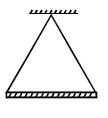
- 2A rod of mass $m$ and length $l$ is suspended from ceiling with two string of length $l$ as shown. When the rod is given a small push in the plane of page and released time period is $T_1$ and when the rod is given a push perpendicular to plane time period of oscillation is $T_2$ . The ratio $\frac{{T_1^2}}{{T_2^2}}$ isView Solution
- 3The general displacement of a simple harmonic oscillator is $x = A \sin \omega t$. Let $T$ be its time period. The slope of its potential energy (U) - time (t) curve will be maximum when $t=\frac{T}{\beta}$. The value of $\beta$ is $.........$View Solution
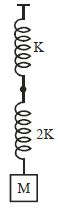
- 4Two springs of force constant $K$ and $2K$ are connected to a mass as shown below. The frequency of oscillation of the mass isView Solution
- 5A particle is executing $S.H.M.$ If its amplitude is $2 \,m$ and periodic time $2$ seconds, then the maximum velocity of the particle will beView Solution
- 6The potential energy of a particle of mass $100 \,g$ moving along $x$-axis is given by $U=5 x(x-4)$, where $x$ is in metre. The period of oscillation is .................View Solution
- 7The resultant of two rectangular simple harmonic motions of the same frequency and equal amplitudes but differing in phase by $\frac{\pi }{2}$ isView Solution
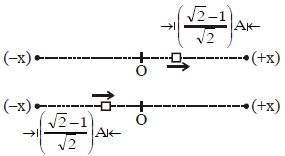
- 8Two bodies performing $SHM$ have same amplitude and frequency. Their phases at a certain instant are as shown in the figure. The phase difference between them isView Solution
- 9A spring is stretched by $0.20\, m$, when a mass of $0.50\, kg$ is suspended. When a mass of $0.25\, kg$ is suspended, then its period of oscillation will be .... $\sec$ $(g = 10\,m/{s^2})$View Solution
- 10Three simple harmonic motions in the same direction having the same amplitude a and same period are superposed. If each differs in phase from the next by ${45^o}$, thenView Solution