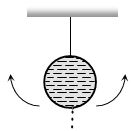
A simple pendulum is made of a body which is a hollow sphere containing mercury suspended by means of a wire. If a little mercury is drained off, the period of pendulum will
Medium
Download our app for free and get started
(b)When a little mercury is drained off, the position of c.g. of ball falls (w.r.t. fixed and) so that effective length of pendulum increases hence T increase.

Download our appand get started for free
Experience the future of education. Simply download our apps or reach out to us for more information. Let's shape the future of learning together!No signup needed.*
Similar Questions
- 1A mass $M$, attached to a horizontal spring, executes S.H.M. with amplitude $A_1$. When the mass $M$ passes through its mean position then a smaller mass $m$ is placed over it and both of them move together with amplitude $A_2$. The ratio of $\frac{{{A_1}}}{{{A_2}}}$ isView Solution
- 2If a body of mass $0.98\, kg$ is made to oscillate on a spring of force constant $4.84\, N/m$, the angular frequency of the body is ..... $ rad/s$View Solution
- 3If $< E >$ and $< U >$ denote the average kinetic and the average potential energies respectively of mass describing a simple harmonic motion, over one period, then the correct relation isView Solution
- 4A simple pendulum is hanging from a peg inserted in a vertical wall. Its bob is stretched in horizontal position from the wall and is left free to move. The bob hits on the wall the coefficient of restitution is $\frac{2}{{\sqrt 5 }}$. After how many collisions the amplitude of vibration will become less than $60°$View Solution
- 5A particle is executing $SHM$ along a straight line. Its velocities at distance $x_1$ and $x_2$ from the mean position are $V_1$ and $V_2$ respectively. Its time period isView Solution
- 6A vibratory motion is represented by $x = 2\,A\,\cos \,\omega t + A\,\cos \,\left( {\omega t + \frac{\pi }{2}} \right) + A\,\cos \,\left( {\omega t + \pi } \right) + \frac{A}{2}\,\cos \,\left( {\omega t + \frac{{3\pi }}{2}} \right)$ The resultant amplitude of motion isView Solution
- 7The maximum velocity of a body undergoing $S.H.M$. is $0.2\,m/s$ and its acceleration at $0.1\,m$ from the mean position is $0.4\,m/s^2$. The amplitude of the $S.H.M.$ is .... $m$View Solution
- 8A body is in simple harmonic motion with time period half second $(T\, = 0.5\, s)$ and amplitude one $cm\, (A\,= 1\, cm)$. Find the average velocity in the interval in which it moves form equilibrium position to half of its amplitude .... $cm/s$View Solution
- 9View SolutionA second's pendulum is mounted in a rocket. Its period of oscillation decreases when the rocket
- 10If $< E >$ and $< U >$ denote the average kinetic and the average potential energies respectively of mass describing a simple harmonic motion, over one period, then the correct relation isView Solution