MCQ
A simple pendulum of length $1\, m$ is oscillating with an angular frequency $10\, rad/s$. The support of the pendulum starts oscillating up and down with a small angular frequency of $1\, rad/s$ and an amplitude of $10^{-2}\, m$. The relative change in the angular frequency of the pendulum is best given by
  • $10^{-3} rad/s$
  • B
    $1\,rad/s$
  • C
    $10^{-1} rad/s$
  • D
    $10^{-5} rad/s$

Answer

Correct option: A.
$10^{-3} rad/s$
a
Angular frequency of pendulum

$\omega \propto \sqrt{\frac{g_{e f f}}{\ell}}$

$\therefore \quad \frac{\Delta \omega}{\omega}=\frac{1}{2} \frac{\Delta g_{e f f}}{g_{e f f}}$

$\Delta \omega=\frac{1}{2} \frac{\Delta g}{g} \times \omega$

$[ \omega_{s}=$ angular frequency of support] 

$\frac{\Delta \omega}{\omega}=\frac{1}{2} \times \frac{\Delta g}{g}$

$=\frac{1}{2} \times \frac{2\left(\mathrm{A} \omega_{5}^{5}\right)}{10}$

$\Rightarrow \frac{\Delta \omega}{\omega}=\frac{1 \times 10^{-2}}{10}=10^{-3}$

Need a full question paper?

Generate a complete, print-ready paper with questions like this in minutes — across 16+ boards, with answer keys.

Start Generating Free

Similar questions

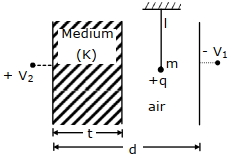
A simple pendulum of mass $'m',$ length $'I'$ and charge $'+q'$ suspended in the electric field produced by two conducting parallel plates as shown. The value of deflection of pendulum in equilibrium position will be -
A body takes $4\, {min}$. to cool from $61^{\circ} {C}$ to $59^{\circ} {C}$. If the temperature of the surroundings is $30^{\circ} {C}$, the time taken by the body to cool from $51^{\circ} {C}$ to $49^{\circ} {C}$ is $....\,min$
A boat moves with a speed of $5 \,km/h $ relative to water in a river flowing with a speed of $3 \,km/h$ and having a width of $1 \,km$. The minimum time taken around a round trip is.........$min$
For given $\vec E = 2x\hat i + 3y\hat j$, find the potential at $(X, Y)$ if potential at origin is $5\, volts.$
A particle of mass $m$ is moving in a circular orbit under the influence of the central force $F(r)=-k r$, corresponding to the potential energy $V(r)=k r^2 / 2$, where $k$ is a positive force constant and $r$ is the radial distance from the origin. According to the Bohr's quantization rule, the angular momentum of the particle is given by $L=n h$, where $h=h /(2 \pi), h$ is the Planck's constant, and $n$ a positive integer. If $v$ and $E$ are the speed and total energy of the particle, respectively, then which of the following expression($s$) is(are) correct?

$(A)$ $r^2=n h \sqrt{\frac{1}{m k}}$

$(B)$ $v^2=n h \sqrt{\frac{k}{m^3}}$

$(C)$ $\frac{L}{m r^2}=\sqrt{\frac{k}{m}}$

$(D)$ $E=\frac{n h}{2} \sqrt{\frac{k}{m}}$

Crystal structure of $NaCl$ is
A closed orgain pipe has length $'l’$. The air in it is vibrating in $3^{rd}$ overtone with maximum displacement amplitude $'a’$. The displacement amplitude at distance $l / 7$ from closed end of the pipe is:
A driving mirror consists of a cylindrical mirror of radius of curvature $10 \,cm$ and the length over the curved surface is $10 \,cm$. If the eye of the driver be assumed to be at a great distance from the mirror, then field of view in radian is
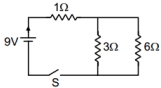
After switch is closed, current drawn from the battery is (in $A$)
A parallel plate capacitor is charged to $60\,\mu C$. Due to a radioactive source, the plate loses charge at the rate of $1.8 \times 10^{-8}\, C/s$. the magnitude of displacement current is