Question
A simple pendulum of length L having a bob of mass m is deflected from its rest position by an angle $\theta$ and released (figure). The string hits a peg which is fixed at a distance x below the point of suspension and the bob starts going in a circle centred at the peg.
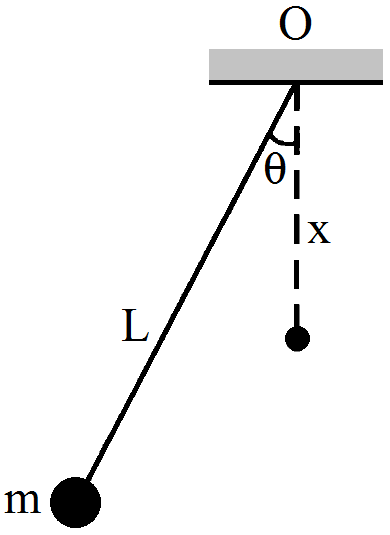
  1. Assuming that initially the bob has a height less than the peg, show that the maximum height reached by the bob equals its initial height.
  2. If the pendulum is released with $\theta=90^\circ$ and $\text{x}=\frac{\text{L}}{2}$ find the maximum height reached by the bob above its lowest position before the string becomes slack.
  3. Find the minimum value of $\frac{\text{x}}{\text{L}}$ for which the bob goes in a complete circle about the peg when the pendulum is released from $\theta=90^\circ.$
Answer


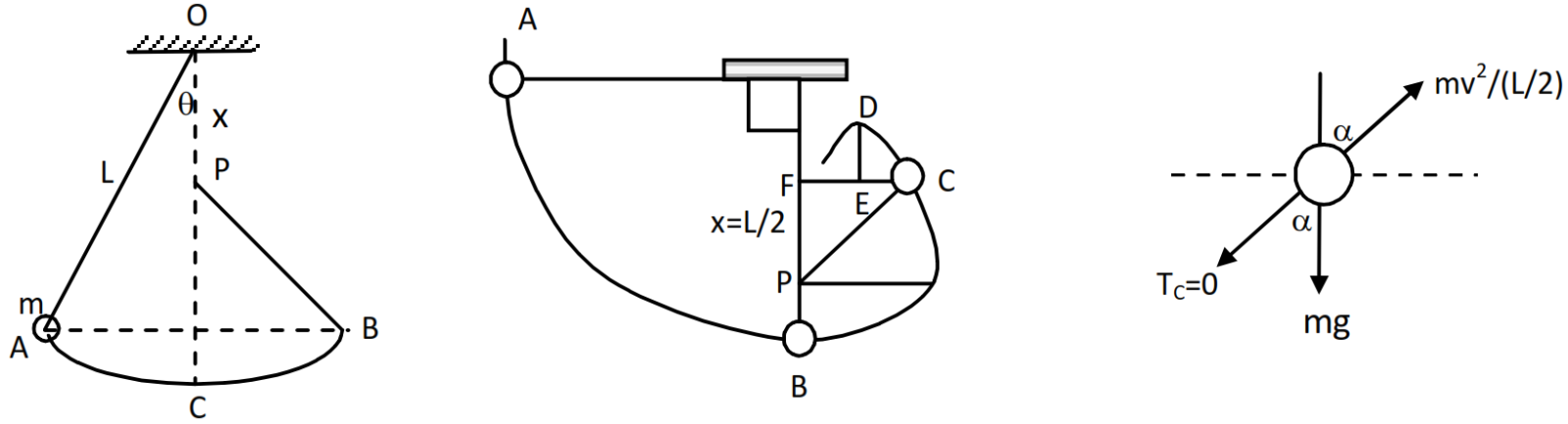
  1. When the bob has an initial height less than the peg and then released from rest (figure), let body travels from A to B.
Since, Total energy at A = Total energy at B
$\therefore (K.E)_A = (PE)_A = (KE)_B + (PE)_B$
$\Rightarrow (PE)_A = (PE)_B [because, (KE)_A = (KE)_B = 0]$
So, the maximum height reached by the bob is equal to initial height.
  1. When the pendulum is released with $\theta=90^\circ$ and $\text{x}=\frac{\text{L}}{2},$ (figure) the path of the particle is shown in the figure.
At point C, the string will become slack and so the particle will start making projectile motion.
$\Rightarrow\Big(\frac{1}{2}\Big)\text{mv}_\text{c}^2-0=\text{mg}\Big(\frac{\text{L}}{2}\Big)(1-\cos\alpha)$
Because, distance between A nd C in the vertical direction is $\frac{\text{L}}{2}(1-\cos\alpha)$
$\Rightarrow\text{v}_\text{c}^2=\text{gl}(1-\cos\alpha)\ \dots(1)$
Again, form the freebody diagram,
$\frac{\text{mv}_\text{c}^2}{\frac{\text{L}}{2}}=\text{mg}\cos\alpha$ [because $T_c = 0$]
So, $\Rightarrow\text{v}_\text{c}^2=\frac{\text{gl}}{2}\cos\alpha\ \dots(2)$
From Eqn.(1) and equn (2),
$\text{gl}(1-\cos\alpha)=\frac{9\text{L}}{2}\cos\alpha$
$\Rightarrow(1-\cos\alpha)=\frac{1}{2}\cos\alpha$
$\Rightarrow\frac{3}{2}\cos\alpha=1$
$\Rightarrow\cos\alpha=\frac{2}{3}\ \dots(3)$
To find highest position C, before the string becomes slack.
$\text{BF}=\frac{\text{L}}{2}+\frac{\text{L}}{2}\cos\theta$
$\text{BF}=\frac{\text{L}}{2}+\frac{\text{L}}{2}\times\frac{2}{3}=\text{L}\Big(\frac{1}{2}+\frac{1}{3}\Big)$
So, $\text{BF}=\frac{5\text{L}}{6}$​​​​​​​
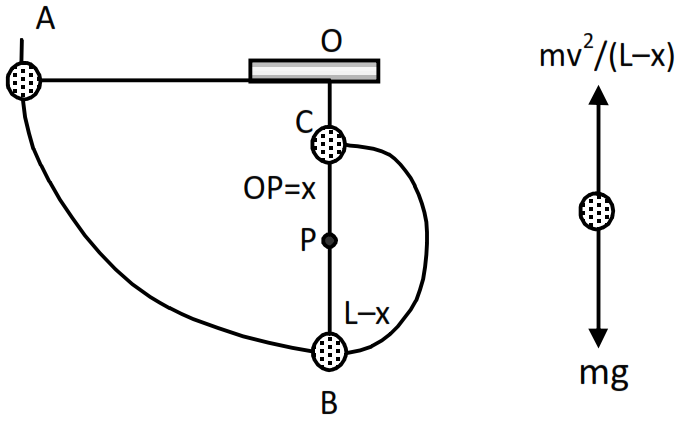
  1. If the particle has to complete a vertical circle, at the point C.


$\frac{\text{mv}_\text{c}^2}{(\text{L}-\text{x})}=\text{mg}$
$\Rightarrow\text{v}_\text{c}^2=\text{g}(\text{L}-\text{x})\ \dots(4)$
Again, applying energy principle between A and C,
$\frac{1}{2}\text{mv}_\text{c}^2-0=\text{mg}(\text{OC})$
$\Rightarrow\frac{1}{2}\text{v}_\text{c}^2-0=\text{mg}[\text{L}-2(\text{L}-\text{x})]$
$\Rightarrow\text{mg}(2\text{x}-\text{L})$
$\Rightarrow\text{v}_\text{c}^2=2\text{g}(2\text{x}-\text{L})\ \dots(5)$
From equn. (4) and equn (5),
$\text{g}(\text{L}-\text{x})=2\text{g}(2\text{x}-\text{L})$
$\Rightarrow\text{L}-\text{x}=4\text{x}-2\text{L}$
$\Rightarrow5\text{x}=3\text{L}$
$\therefore\ \frac{​​​​\text{x}}{\text{L}}=\frac{3}{5}=0.6$
So, the rates $\Big(\frac{\text{x}}{\text{L}}\Big)$ should be 0.6

Need a full question paper?

Generate a complete, print-ready paper with questions like this in minutes — across 16+ boards, with answer keys.

Start Generating Free

Similar questions

An electric current flows in a wire from north to south. What will be the direction of the magnetic field due to this wire at a point east of the wire? West of the wire? Vertically above the wire? Vertically below the wire?
Find the accelerations $a_1, a_2, a_3$ of the three blocks shown in figure if a horizontal force of $10N$ is applied on:
  1. 2kg block.
  2. 3kg block.
  3. 7kg block. Take $g = 10m/s^2$.
Earthquakes generate sound waves inside the earth. Unlike a gas, the earth can experience both transverse $(S)$ and longitudinal ( $P$ ) sound waves. Typically the speed of $S$ wave is about $4.0 km s ^{-1}$, and that of $P$ wave is $8.0 km s ^{-1}$. A seismograph records $P$ and $S$ waves from an earthquake. The first $P$ wave arrives $4$ min before the first S wave. Assuming the waves travel in straight line, at what distance does the earthquake occur?
A satellite is in an elliptic orbit around the earth with aphelion of $6R$ and perihelion of 2R where $R = 6400km$ is the radius of the earth. Find eccentricity of the orbit. Find the velocity of the satellite at apogee and perigee. What should be done if this satellite has to be transferred to a circular orbit of radius $6R$?[$G = 6.67 \times 10^{–11}$ SI units and $4M = 6 \times 10^{24}kg$]
An insulated container containing monoatomic gas of molar mass m is moving with a velocity $v_0$. If the container is suddenly stopped, find the change in temperature.
A body starts slipping down an incline and moves half meter in half second. How long will it take to move the next half meter?
State parallelogram law of vector addition and find the magnitude and direction of resultant of two vectors $\vec{\text{A}}$ and $\vec{\text{B}}$ in terms of their magnitude and angle between them.
A shell of mass $0.020kg$ is fired by a gun of mass $100kg$. If the muzzle speed of the shell is $80ms^{-1}$, what is the recoil speed of the gun?
The position of a particle is given by $\text{r}=3.0\text{t}\hat{\text{i}}-2.0\text{t}^2\hat{\text{j}}+4.0\hat{\text{k }}\text{m}$ Where t is in seconds and the coefficients have the proper units for r to be in metres. (a) Find the v and a of the particle? (b) What is the magnitude and direction of velocity of the particle at t = 2.0s?
Two cylindrical hollow drums of radii R and 2R, and of a common height h, are rotating with angular velocities $\omega$ (anti-clockwise) and $\omega$ (clockwise), respectively. Their axes, fixed are parallel and in a horizontal plane separated by $(3\text{R}+\delta).$ They are now brought in contact $(\delta\rightarrow0){:}$
  1. Show the frictional forces just after contact.
  2. Identify forces and torques external to the system just after contact.
  3. What would be the ratio of final angular velocities when friction ceases?