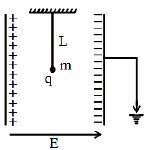
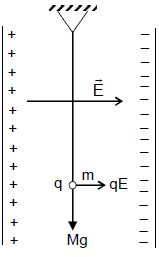
A simple pendulum of length $L$ is placed between the plates of a parallel plate capacitor having electric field $E,$ as shown in figure. Its bob has mass $m$ and charge $q.$ the time period of the pendulum is given by
JEE MAIN 2019, Diffcult


Download our appand get started for free
Experience the future of education. Simply download our apps or reach out to us for more information. Let's shape the future of learning together!No signup needed.*
Similar Questions
- 1Two identical electric point dipoles have dipole moments $\overrightarrow{p}_{1}= p\hat i$ and $\overrightarrow{p}_{2}=- p\hat i$ and are held on the $x-$axis at distance $'a'$ from each other. When released, they move along the $x-$axis with the direction of their dipole moments remaining unchanged. If the mass of each dipole is $'m',$ their speed when they arc infinitely far apart isView Solution
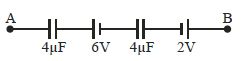
- 2A part of circuit is given here, if $V_A-V_B = 4V$ then find charge on $4\,\mu F$ capacitor.....$\mu C$View Solution
- 3Two condensers of capacities $2C$ and $C$ are joined in parallel and charged upto potential $V$. The battery is removed and the condenser of capacity $C$ is filled completely with a medium of dielectric constant $K$. The $p.d.$ across the capacitors will now beView Solution
- 4When air in a capacitor is replaced by a medium of dielectric constant $K$, the capacityView Solution
- 5A $10\ \mu F$ capacitor is charged to a potential difference of $1000\ V$. The terminals of the charged capacitor are disconnected from the power supply and connected to the terminals of an uncharged $6\ \mu F$ capacitor. What is the final potential difference across each capacitor.....$V$View Solution
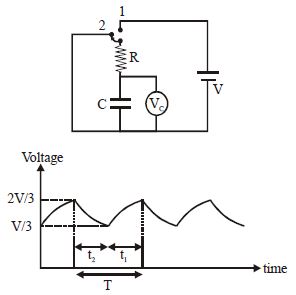
- 6The switch in circuit shifts from $1$ to $2$ when $V_C > 2V/3$ and goes back to $1$ from $2$ when $V_C < V/3$ . The voltmeter reads voltage as plotted. What is the period $T$ of the wave form in terms of $R$ and $C$ ?View Solution
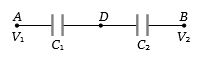
- 7Two condensers ${C_1}$and ${C_2}$ in a circuit are joined as shown in figure. The potential of point $A$ is ${V_1}$ and that of $B$ is ${V_2}$. The potential of point $D$ will beView Solution
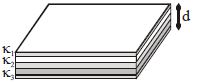
- 8A parallel plate capacitor is filled with $3$ dielectric materials of same thickness, as shown in the sketch. The dielectric constants are such that $k_3 > k_2 > k_1$. Let the magnitudes of the electric field in and potential drops across each dielectric be $E_3$, $E_2$,$ E_1$, $\Delta V_3$, $\Delta V_2$ and $\Delta V_1$, respectively. Which one of the following statement is true ?View Solution
- 9Two identical capacitors, have the same capacitance $C$. One of them is charged to potential ${V_1}$ and the other to ${V_2}$. The negative ends of the capacitors are connected together. When the positive ends are also connected, the decrease in energy of the combined system isView Solution
- 10We have three identical metallic spheres $A, B$ and $C$. $A$ is given a charge $Q$, and $B$ and $C$ are uncharged. The following processes of touching of two spheres are carried out in succession. Each process is carried out with sufficient time.View Solution
$(i)$ $A$ and $B$ $(ii)$ $B$ and $C$
$(iii)$ $C$ and $A$ $(iv)$ $A$ and $B$
$(v)$ $B$ and $C$
The final charges on the spheres are