Question
A simple pendulum performs S.H.M. about x = 0 with an amplitude a and time period T. What is the speed of the pendulum at $\text{x}=\frac{\text{A}}{2}?$

Answer

Velocity of oscillating body $=\text{v}=\omega\sqrt{\text{A}^2-\text{x}^2}$$\text{x}=\frac{\text{A}}{2}$
$\text{v}=\omega\sqrt{\text{A}^2-\Big(\frac{\text{A}^2}{4}\Big)}$
$=\frac{\sqrt{3}\text{A}\omega}{2}=\frac{\sqrt{3}\text{A}\pi}{\text{T}}$

Need a full question paper?

Generate a complete, print-ready paper with questions like this in minutes — across 16+ boards, with answer keys.
Start Generating Free

Similar questions

Can a body have energy without having momentum and have momentum without having energy? Explain.
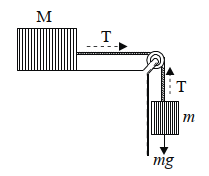
According to the figure, if the coefficient of static friction between block of mass 2 kg and the table is $\mu_s=0.2$ then what should be the maximum value of $m$ so that the block does not move while the pulley is light and frictionless.
Image
In order to have a current in a long wire, it should be connected to a battery or some such device. Can we obtain the magnetic due to a straight, long wire by using Ampere's law without mentioning this other part of the circuit?
A monkey climbs up a slippery pole for 3 seconds and subsequently slips for 3 seconds. Its velocity at time t is given by v(t) = 2t(3 - t); 0 < t < 3 and v(t) = -(t - 3)(6 - t) for 3 < t < 6s in m/s. It repeats this cycle till it reaches the height of 20m.
At what time is its velocity maximum?
What is meant by cyclic process? Prove that the heat absorbed in cyclic process is equal to the work done by it.
A boy standing on a long railroad car throws a ball straight upwards. The car is moving on the horizontal road with an acceleration of $1m/s^2$ and the projection velocity in the vertical direction is $9.8m/s$. How far behind the boy will the ball fall on the car?
A cylinder of fixed capacity 44.8 litres contains helium gas at standard temperature and pressure. What is the amount of heat needed to raise the temperature of the gas in the cylinder by $15.0^{\circ} C ?\left(R=8.31 J mol ^{-1} K ^{-1}\right)$.
An electric field $\vec{\text{E}}=(\vec{\text{i}}20+\vec{\text{j}}30)\text{N}\text{C}^{-1}$ exists in the space. If the potential at the origin is taken to be zero, find the potential at (2m, 2m).
If an object far away from a convex mirror moves towards the mirror, the image also moves. Does it move faster, slower or at the same speed as compared to the object?
The charge on a proton is $+1.6 \times 10^{-19} \mathrm{C}$ and that on an electron is $-1.6 \times 10^{-19} \mathrm{C}$. Does it mean that the electron has a charge $3.2 \times 10^{-19} \mathrm{C}$ less than the charge of a proton?