Question
According to the figure, if the coefficient of static friction between block of mass 2 kg and the table is $\mu_s=0.2$ then what should be the maximum value of $m$ so that the block does not move while the pulley is light and frictionless.
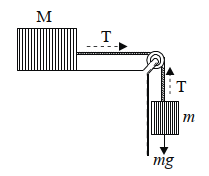
Image

Answer

 Given
$\begin{array}{l}
M=2 kg \\
\mu_s=0.2
\end{array}$
Maximum value of $m=$ ?
$\begin{array}{rlrl}
\Rightarrow & Mg \times \mu_s & =m g \\
\Rightarrow & M \times \mu_s & =m \\
\therefore & m  =2 \times 0.2 \\
&=0.4 kg\quad \text { Ans. }
\end{array}$

Need a full question paper?

Generate a complete, print-ready paper with questions like this in minutes — across 16+ boards, with answer keys.
Start Generating Free

Similar questions

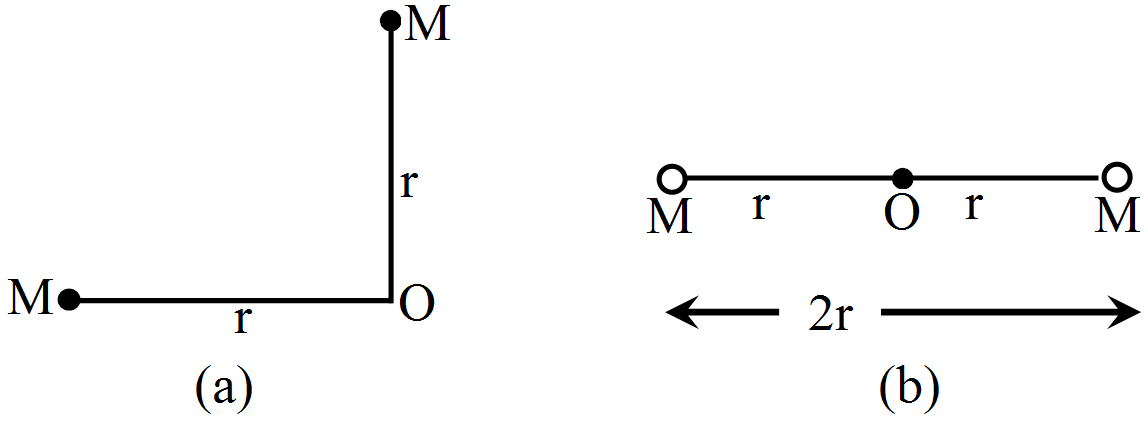
The masses M in the two figures are identical. Which of the two systems has the smaller gravitational potential energy? Why?
The decay constant of $\text{ }^{197}_{80}\text{Hg} ($electron capture to $\text{ }^{197}_{79}\text{Au})$ is $1.8 \times 10^{-4} S^{-1}$.
  1. What is the half$-$life?
  2. What is the average$-$life?
  3. How much time will it take to convert $25\%$ of this isotope of mercury into gold?
An observer at a sea-coast observes waves reaching the coast. What type of waves does he observe? Why?
0.1 mole of nitrogen gas is heated from $27^{\circ} C$ to $327^{\circ} C$ at atmospheric pressure. Find the heat given, work done by the gas and change in internal energy of the gas. For nitrogen $C_r=6.93$ and $C_v=4.96$ $cal / mol /{ }^{\circ} C$.
Explain why The size of the needle of a syringe controls flow rate better than the thumb pressure exerted by a doctor while administering an injection.
An inductor-coil carries a steady-state current of 2.0A when connected across an ideal battery of emf 4.0V. If its inductance is 1.0H, find the time constant of the circuit.
Answer the following: You are given a thread and a metre scale. How will you estimate the diameter of the thread?
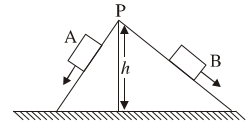
Two smooth inclined planes are shown in the figure. On these, two objects $A$ and $B$ of equal masses start sliding from rest from point $P$. Which object will reach the ground with greater speed?
Image
What is the resistance of an intrinsic semiconductor at 0K?
Is the rate of cooling the same thing as the rate of loss of heat? Explain.