A simple pendulum performs simple harmonic motion about $X = 0$ with an amplitude $A$ and time period $T$. The speed of the pendulum at $X = \frac{A}{2}$ will be
Medium
Download our app for free and get started
(a)Velocity of a particle executing $S.H.M.$ is given by
$v = \omega \sqrt {{a^2} - {x^2}} $
$= \frac{{2\pi }}{T}\sqrt {{A^2} - \frac{{{A^2}}}{4}} $
$= \frac{{2\pi }}{T}\sqrt {\frac{{3{A^2}}}{4}}$
$= \frac{{\pi A\sqrt 3 }}{T}$.

Download our appand get started for free
Experience the future of education. Simply download our apps or reach out to us for more information. Let's shape the future of learning together!No signup needed.*
Similar Questions
- 1Due to some force $F_1$ a body oscillates with period $4/5\, sec$ and due to other force $F_2$ oscillates with period $3/5\, sec$. If both forces act simultaneously, the new period will be .... $\sec$View Solution
- 2A simple pendulum oscillating in air has period $T.$ The bob of the pendulum is completely immersed in a non-viscous liquid. The density of the liquid is $\frac {1}{16}$ of the material of the bob. If the bob is inside liquid all the time, its period of oscillation in this liquid isView Solution
- 3Time period of a simple pendulum in a stationary lift is ' $T$ '. If the lift accelerates with $\frac{ g }{6}$ vertically upwards then the time period will be .....View Solution
(where $g =$ acceleration due to gravity)
- 4If $x = a\sin \left( {\omega t + \frac{\pi }{6}} \right)$ and $x' = a\cos \omega t$, then what is the phase difference between the two wavesView Solution
- 5The acceleration displacement graph of a particle executing $SHM$ is shown in figure. The time period of simple harmonic motion isView Solution
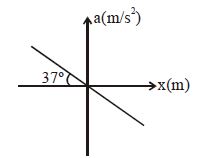
- 6The maximum speed of a particle executing $S.H.M.$ is $1\,m/s$ and its maximum acceleration is $1.57\,m/se{c^2}$. The time period of the particle will be .... $\sec$View Solution
- 7A mass at the end of a spring executes harmonic motion about an equilibrium position with an amplitude $A.$ Its speed as it passes through the equilibrium position is $V.$ If extended $2A$ and released, the speed of the mass passing through the equilibrium position will beView Solution
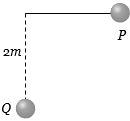
- 8A pendulum of length $2\,m$ lift at $P$. When it reaches $Q$, it losses $10\%$ of its total energy due to air resistance. The velocity at $Q$ is .... $m/sec$View Solution
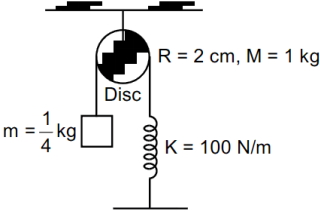
- 9View SolutionFor the system given below, find the angular frequency of oscillation ?
- 10A particle of mass $10\, gm$ is describing $S.H.M.$ along a straight line with period of $2\, sec$ and amplitude of $10, cm$. Its kinetic energy when it is at $5 \,cm$ from its equilibrium position isView Solution