MCQ
A sine wave of wavelength $\lambda $ is travelling in a medium. The minimum distance between the two particles, always having same speed, is
  • A
    $\frac{\lambda }{4}$
  • B
    $\frac{\lambda }{3}$
  • $\frac{\lambda }{2}$
  • D
    $\lambda $

Answer

Correct option: C.
$\frac{\lambda }{2}$
c
In a sine wave particles that are separated by a distance of odd multiple of half the wave length move with same speed and but in opposite direction. The minimum separation is $\frac{\lambda}{2}$

Need a full question paper?

Generate a complete, print-ready paper with questions like this in minutes — across 16+ boards, with answer keys.
Start Generating Free

Similar questions

A satellite of mass m is at a distance of $'a'$ from a star of mass $M.$ The speed of the satellite is $u.$ Suppose the law of universal gravity is $F=-G\frac{Mm}{r^{2.1}}$ instead of $F=-G\frac{Mm}{r^{2}}$ find the speed of the satellite when it is at $a$ distance $b$ from the star.
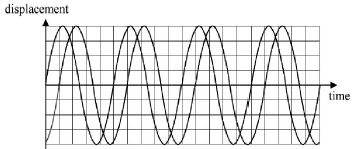
The diagram shows two oscillations. What is the phase difference between the oscillations?
A policeman on duty detects a drop of $10 \%$ in the pitch of the hom of motion of car as it crosses him. If the velocity of sound is $330 \,m / s$. Calculate the speed of the car ........... $m / s$
The value of coefficient of volume expansion of glycerin is $5 \times 10^{-4}k^{-1} .$ The fractional change in the density of glycerin for a rise of $40^o C$ in its temperature, is
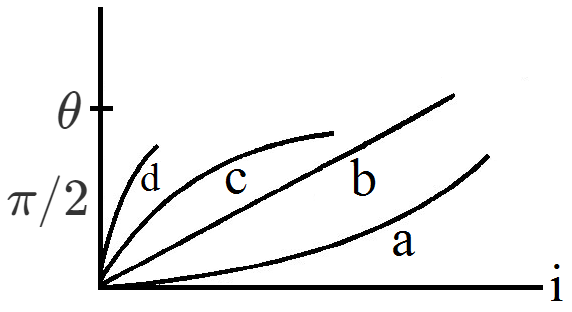
Which of the following four graphs may best represent the current$-$deflection relation in a tangent galvanometer?
Motion of an oscillating liquid column in a $U-$tube is:
At a given temperature the root mean square velocities of oxygen and hydrogen molecules are in the ratio
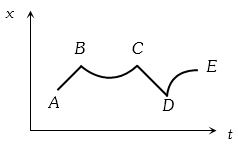
Figure shows the displacement of a particle going along the $X-$axis as a function of time. The force acting on the particle is zero in the region
A 100 m long train is moving with a uniform velocity of $45 km / h$. The time taken by the train to cross a bridge of length 1 km is:
The time dependence of a physical quantity $P$  is given by $P\, = \,{P_0}\,{e^{ - \alpha {t^2}}}$ where $\alpha $ is a constant and $t$ is the time then constant $\alpha $ is